

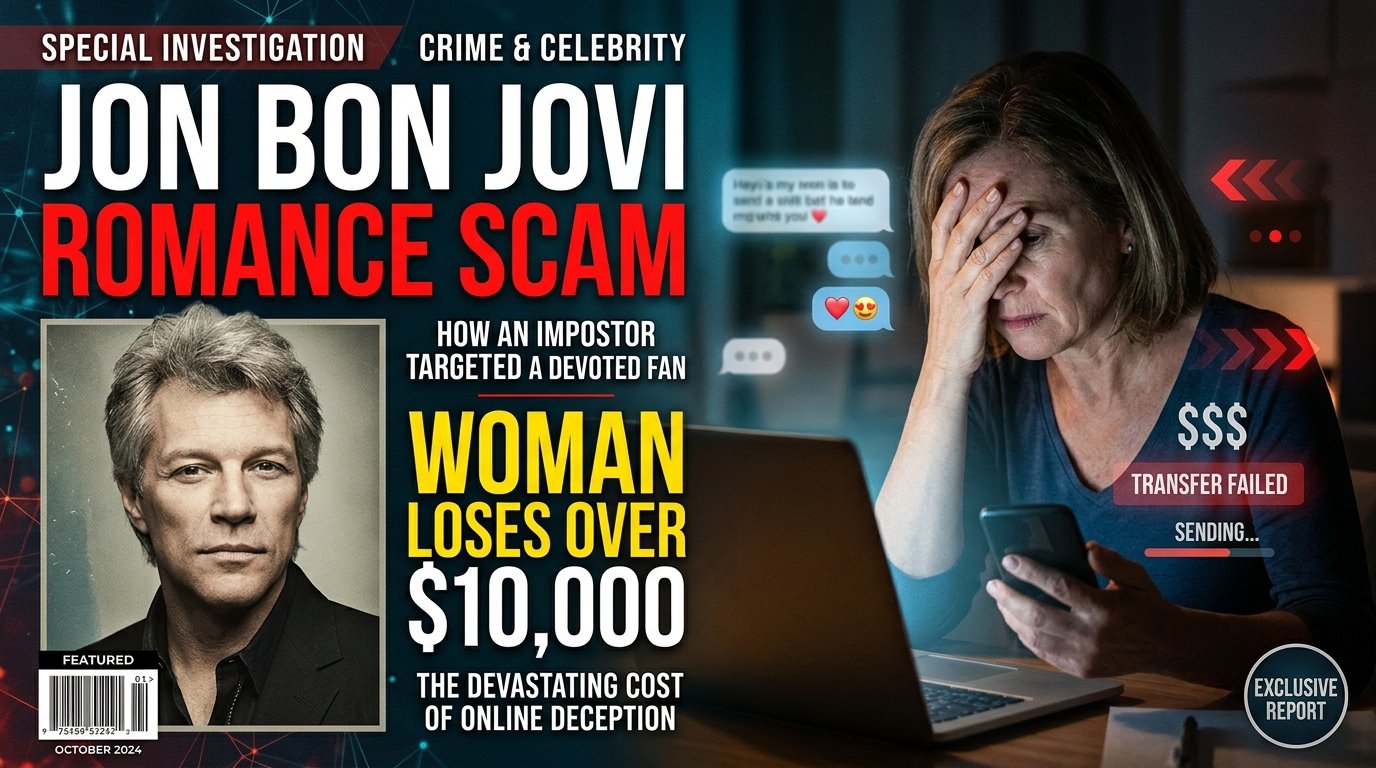
A Jon Bon Jovi romance scam has highlighted the growing risks of online relationships involving fake celebrity accounts and convincing artificial intelligence (AI) videos. Leslie Pickett, a Louisiana resident and longtime fan of the rock singer, says she lost more than $10,000 after believing she had developed a personal relationship with him.
Pickett’s experience is featured in Super Scam Me, a National Geographic documentary special presented by investigative journalist Mariana van Zeller. The program examines how romance scammers manipulate victims, use digital technology to build trust, and demand money under false pretenses.
According to Pickett’s account, the deception lasted for months and left her facing serious financial difficulties. She also described lasting emotional effects, including difficulty trusting other people.
Her experience offers a warning about celebrity impersonation scams, particularly when online affection turns into requests for cryptocurrency or other payments.
How the Jon Bon Jovi Romance Scam Began
Pickett said her experience started in late 2024, after her daughter introduced her to Instagram. She visited what she understood to be Jon Bon Jovi’s official account and commented on one of his posts.
A separate account responded shortly afterward. Although it appeared to represent the singer, Pickett later recognized that the account did not have the same verification status as his official profile.
Initially, the conversations seemed genuine to her. The person messaging her reportedly offered thoughtful responses and claimed that Bon Jovi wanted to communicate more privately with his fans.
The account also allegedly suggested that the singer’s management would shut down the private profile if the secret communication became known.
Pickett said she had doubts but wanted to believe the connection was real. Over time, the frequent conversations helped build her trust in the person behind the account.
Personal Messages Made the Impersonation Convincing
According to Pickett, the conversations continued throughout the day and sometimes late into the night. The individual discussed music, everyday experiences and shared interests.
The supposed singer also expressed romantic feelings and sent flowers to her home. Pickett said he shared recorded videos and participated in a brief live video interaction.
The account allegedly claimed that Bon Jovi was quietly divorcing his wife and wanted a relationship with someone outside the celebrity world.
These claims helped create the impression of a private, personal relationship rather than a conversation with a stranger.
Pickett even showed some of the material to a cousin who initially questioned the story. However, she said the images and videos appeared convincing enough to reinforce her belief.
The experience demonstrates how scammers can exploit a person’s admiration for a celebrity while using regular communication to establish emotional trust.
When the Fake Celebrity Started Asking for Money
The situation changed several months into the relationship when the person posing as Bon Jovi began discussing payments.
Pickett said she had hoped to attend a legitimate performance in Nashville but could not obtain tickets before they sold out. The impersonator allegedly offered to arrange a private meet-and-greet through the singer’s management.
He then directed her toward supposed management contacts and explained how to make payments.
According to Pickett, the initial requests involved relatively small sums, often around $100 to $150. When payments allegedly failed, she was instructed to try again or use a different method.
The requested payments eventually involved services such as Venmo, PayPal and Cash App, as well as Bitcoin.
Pickett said she was unfamiliar with cryptocurrency and relied on the instructions provided by the person she believed was Bon Jovi.
Cryptocurrency Requests Became a Major Warning Sign
The requests became increasingly difficult to explain as the money failed to produce the promised meeting.
Pickett said the impersonator reassured her that cryptocurrency was safer than conventional payment methods. That explanation helped persuade her to continue despite her concerns.
However, the promised arrangements never materialized.
The Federal Trade Commission (FTC) warns that romance scammers commonly build relationships before requesting money through payment apps, wire transfers, gift cards or cryptocurrency. These payment methods can make it difficult to recover stolen funds.
The agency advises people not to send money or gifts to someone they have not met in person, regardless of how convincing the relationship appears.
For Pickett, the financial warning signs became harder to ignore as the payments accumulated and the expected meeting remained out of reach.
AI Videos Helped the Scammer Maintain the Illusion
One of the most concerning aspects of the Jon Bon Jovi romance scam was the reported use of convincing video content.
Pickett said the person sent recordings that appeared to show the singer speaking directly to her. In some videos, he reportedly used her name, making the messages seem personalized.
She also described testing the account by asking the supposed singer to perform specific facial movements. The person sent a video appearing to follow her instructions shortly afterward.
These interactions strengthened her belief that she was communicating with the real musician.
Modern AI tools can generate or manipulate images, voices and video to make impersonation more believable. Although some fabricated media contains obvious errors, other examples can appear convincing to viewers.
As a result, a video message should not be treated as conclusive proof of someone’s identity.
Scammers can also combine fabricated media with information taken from public social media profiles. This allows them to make their messages appear more personal and consistent with a victim’s interests.
In Pickett’s case, the combination of frequent communication, romantic promises and realistic-looking videos made it increasingly difficult for her to separate the apparent relationship from the deception.
A Promised Meeting Raised More Questions
In July 2025, the person posing as Bon Jovi allegedly told Pickett that he was traveling to Louisiana for a meet-and-greet.
Pickett said he sent photographs that appeared to show him at a hotel she recognized. She believed the familiar surroundings supported his claim that he was nearby.
However, the meeting did not take place.
According to her account, the impersonator introduced an additional security-clearance requirement through Google Chat. When she attempted to join a video call, the connection was abruptly ended.
He allegedly blamed the incident on a security concern involving his management and suggested that another clearance process could be arranged if she made an additional payment in Bitcoin.
By this stage, Pickett had become increasingly suspicious. The latest request prompted her to question whether the relationship had ever been genuine.
She subsequently contacted van Zeller for help investigating the deception.
Investigation Traced the Suspected Scammer to Nigeria
Van Zeller and Pickett worked with Arman Sadri, a former hacker who now works in cybersecurity, to investigate the person behind the messages.
As described in the documentary and Pickett’s account, the team used an investigative technique to obtain information that helped them trace the online activity.
The resulting IP-address information pointed toward Lagos, Nigeria. The team also used Google Earth to examine a location they believed was connected to the person communicating with Pickett.
An IP address can provide clues about the location associated with an internet connection, but it does not necessarily identify the individual operating an account or establish a person’s exact physical location.
The reported findings nevertheless gave Pickett a clearer explanation for the deception she had experienced.
By then, she said she had lost more than $10,000. Her financial difficulties had become so serious that she faced the possibility of losing her home to foreclosure.
The investigation formed part of Super Scam Me, which explores the methods used by romance scammers and the challenges involved in identifying them.
Leslie Pickett Describes the Emotional Cost of the Scam
The financial losses were only part of Pickett’s experience.
She said the realization that the relationship was based on deception left her devastated. She had invested months of emotional energy in someone she believed cared about her.
The discovery also affected her ability to trust people.
Pickett has continued working while trying to rebuild her finances. She has also used social media to warn others about fake celebrity profiles and the dangers of sending money to people they know only online.
Her decision to speak publicly reflects a wider challenge faced by romance-scam victims: embarrassment can make people reluctant to report what happened or seek support.
However, being deceived does not mean someone is unintelligent or careless. These schemes can involve prolonged manipulation, carefully prepared stories and repeated reassurance designed to overcome doubts.
Pickett’s experience shows why awareness should focus on the tactics used by scammers rather than blaming the people they target.
What Is Super Scam Me About?
Super Scam Me is a National Geographic documentary special featuring investigative journalist Mariana van Zeller.
The program examines online romance scams and the techniques criminals use to build relationships with people before requesting money.
Van Zeller investigates the operation of these schemes, including the use of digital tools and emotional manipulation. The documentary also follows efforts to understand who is behind the accounts and how victims can identify the deception.
Pickett’s story provides a personal example of how an apparent celebrity relationship can develop into a financial scam.
National Geographic lists the documentary as available through its streaming distribution, with viewing options including Disney+ and Hulu. Availability may vary by country and subscription.
For viewers, the story is a reminder that a recognizable face, convincing video or apparently intimate conversation cannot guarantee that an online contact is genuine.
How to Protect Yourself From Celebrity Romance Scams
The Jon Bon Jovi romance scam illustrates several warning signs that people can watch for when communicating with someone who claims to be famous.
The following precautions can help reduce the risk of financial loss.
1. Check the Account Carefully
Visit the celebrity’s official website and follow links to their recognized social media accounts. Do not assume that an account is genuine simply because it uses a famous person’s name, photographs or biography.
Verification indicators can be helpful, but platform rules differ. Check the account’s history and official links rather than relying on a single symbol.
2. Never Pay for a Secret Relationship
Treat requests for money from an online romantic interest as a serious warning sign, particularly when the person claims to be a celebrity.
Be cautious of payments described as fees for private meetings, security checks, confidential access or special fan privileges.
Verify any legitimate event or meet-and-greet through the artist’s official website or an authorized ticket seller.
3. Do Not Rely on Video Alone
AI-generated videos and manipulated recordings can make impersonation more convincing.
A live video call can also be misleading. Avoid treating a brief call or personalized recording as sufficient evidence of identity, especially if the person continues to avoid a verifiable meeting while requesting money.
4. Be Careful With Cryptocurrency
Cryptocurrency transfers can be difficult or impossible to reverse.
Never transfer Bitcoin or other digital assets because someone claiming to be a celebrity or romantic partner says it is necessary to prove your loyalty, secure a meeting or protect a relationship.
5. Talk to Someone You Trust
Discuss suspicious requests with a friend or family member before sending money. An outside perspective can help identify inconsistencies that may be difficult to notice when emotions are involved.
If you believe you have been targeted, stop sending money, preserve messages and transaction records, and report the account to the platform. Contact your bank, payment provider or cryptocurrency exchange promptly to ask whether any recovery steps are available.
In the United States, suspected romance scams can be reported to the FTC at ReportFraud.ftc.gov. People in other countries should contact their local consumer-protection or cybercrime authorities.
Final Thoughts
Leslie Pickett’s experience shows how a celebrity impersonation scam can develop gradually, using emotional connection and convincing digital content before introducing financial demands.
The reported loss of more than $10,000 and the threat to her home underline the potential consequences of these schemes.
As AI tools make digital impersonation more convincing, online users need to verify identities independently and treat requests for money as a reason to pause.
A genuine connection should never require someone to send cryptocurrency to prove their affection or pay for a secret meeting with a celebrity.


