

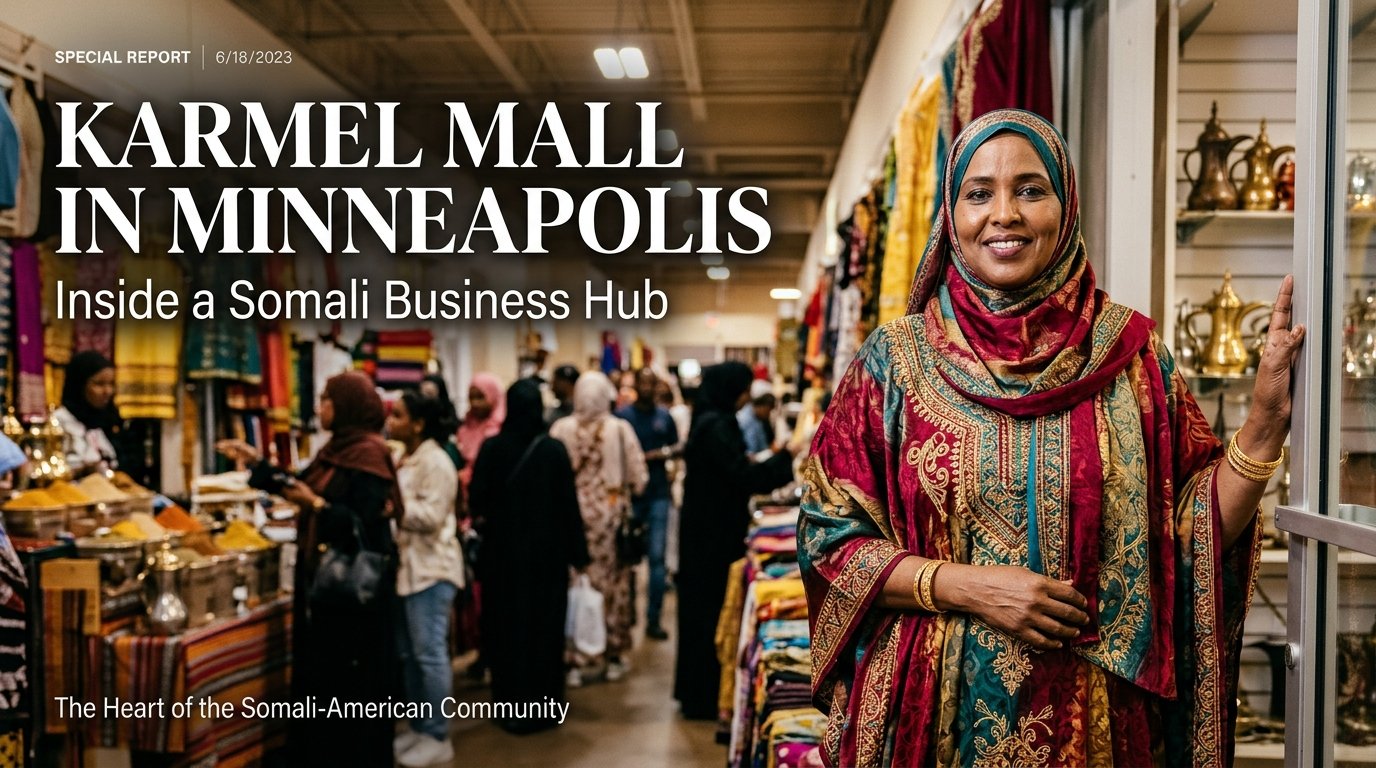
Karmel Mall in Minneapolis is a well-known gathering place for Somali businesses, traditional food vendors, clothing shops and community services. Located near Lake Street, the mall reflects the commercial and cultural connections that shape everyday life for many Somali Americans in Minnesota.
The shopping centre also attracted public attention on October 23, 2026, when U.S. Representative Ilhan Omar appeared in Minneapolis following a federal search of her Washington, D.C., home earlier that month. Reports placed Omar at Karmel Mall alongside Minnesota Attorney General Keith Ellison.
Beyond the political headlines, the mall offers a closer look at small-business activity, cultural traditions and the role of local commercial spaces in supporting immigrant communities.
What Is Karmel Mall in Minneapolis?
Karmel Mall, also known as the Karmel Mall of Somalia, is a commercial property in Minneapolis associated with the city’s Somali community. The property brings together independent businesses, food outlets and services that connect customers with East African products and everyday needs.
According to its property owner, Sabri Properties, the complex includes the original mall and a newer expansion connected within the same development. The property is located at 200 W. Lake Street and 2910 Pillsbury Avenue South.
Unlike a conventional shopping mall dominated by national retail chains, Karmel Mall has a strong focus on independent merchants and culturally specific services.
Its businesses serve customers looking for traditional clothing, prepared meals, international communication services and assistance with travel and money transfers.
Ilhan Omar’s Visit Brings Attention to the Mall
Karmel Mall drew additional attention on October 23, when Minnesota Representative Ilhan Omar made a public appearance in Minneapolis.
Minnesota Public Radio reported that Omar cast her ballot that day but did not attend a planned press conference. Coverage from Fox News Digital also placed her at Karmel Mall, where she was seen with Minnesota Attorney General Keith Ellison and members of the local community.
The visit came less than two weeks after federal agents searched Omar’s Washington residence on October 12. Her congressional office issued a statement about the search, which became a subject of wider political debate.
However, the mall’s significance extends beyond its connection to a prominent elected official. It is also a place where entrepreneurs operate businesses, customers meet and community members maintain cultural ties.
Small Businesses and Services Under One Roof
One of the defining features of Karmel Mall is its mix of independently operated shops and service providers.
The businesses described in reporting about the complex include several categories that serve both local residents and customers with connections to East Africa.
Traditional Clothing and Personal Services
Clothing stores offer garments associated with Somali and broader East African traditions. Such shops give customers access to familiar styles and products that may be harder to find in mainstream retail stores.
Barbers and other personal-service businesses also operate within the mall, providing convenient services for people who live or work nearby.
Money Transfers and International Communication
Money-transfer businesses and shops selling prepaid SIM cards are another part of the mall’s commercial mix.
These services can help customers communicate internationally and send money to relatives or other recipients abroad. For families with cross-border ties, access to such services can be an important part of everyday life.
Individual providers have their own fees, terms and service areas, so customers should check those details directly before making a transaction.
Travel Agencies and Community Services
Travel agencies serving customers interested in trips to the Middle East and East Africa have also been reported among the mall’s tenants.
Together, these businesses illustrate how a neighbourhood commercial centre can meet practical needs while supporting relationships that extend beyond the United States.
Somali Food and Community Gathering Spaces
Food is another important part of the Karmel Mall experience.
Accounts of the complex describe eateries serving Somali dishes and other familiar foods. These dining spaces offer customers an opportunity to eat together, socialise and maintain connections to culinary traditions.
Popular Somali dishes include sambusas, which are pastry pockets commonly filled with seasoned meat or vegetables, and rice served with meat, including goat. Recipes and preparation methods vary between restaurants and households.
The mall’s dining areas also provide a meeting place for people who may visit for reasons beyond shopping.
For many immigrant communities, restaurants and shared dining spaces can serve as informal social centres. They offer opportunities to catch up with friends, exchange news and introduce younger generations to traditional food.
At Karmel Mall, these everyday interactions form part of the property’s broader role in Minneapolis.
Basim Sabri’s Vision for Karmel Mall
Basim Sabri, the property’s owner, has described the mall as a place where entrepreneurs can establish businesses and develop them over time.
In an interview published by Fox News Digital, Sabri characterised the complex as an incubator for small businesses. He said some merchants eventually expand and move into larger premises as their companies grow.
That model can be important for entrepreneurs who want to establish a customer base before committing to a larger retail location.
Independent commercial spaces can also provide access to customers who already know the products, services and cultural traditions offered by local merchants.
Sabri Properties’ description of the development highlights the connection between its original section and a newer expansion, which includes residential apartments on upper floors. This arrangement combines commercial activity with nearby housing.
Sabri’s broader business history has also received media attention, including reporting on a federal bribery conviction in 2005. That history is separate from the mall’s day-to-day commercial activity and should be considered in its own documented context.
Karmel Mall and Minneapolis’s Somali Community
Minneapolis is home to a substantial Somali American community, and commercial spaces such as Karmel Mall provide a setting for businesses to serve customers with shared cultural and practical needs.
These spaces can help preserve access to traditional foods, clothing and language while creating opportunities for entrepreneurship.
At the same time, a community-focused shopping centre should not be viewed as representative of every Somali American’s experiences or views. The community includes people with different occupations, backgrounds, political opinions and personal circumstances.
Karmel Mall’s businesses also have a wider potential customer base. People from other backgrounds can visit to explore the shops, buy food and use available services.
For local entrepreneurs, the combination of regular customers and specialised products can create a distinct commercial identity. For visitors, it offers a window into the variety of businesses operating within Minneapolis.
What Makes Karmel Mall Different From a Traditional Mall?
Traditional American malls often feature large department stores, national fashion brands and centralised food courts. Karmel Mall’s reported mix of smaller independent businesses gives it a different commercial character.
Its merchants offer specialised products and services, including traditional clothing, international money transfers and East African food.
The business model also creates opportunities for entrepreneurs to reach customers within a concentrated retail environment. As Sabri has explained, some businesses use the mall as a starting point before moving into larger premises.
Although the property’s owner has described it as the largest Somali mall in the world, that distinction should be treated as an attributed claim rather than an independently established global ranking.
The more important point is its local role: Karmel Mall provides a shared commercial setting where businesses, services and community life intersect.
Why Karmel Mall Matters Beyond the Headlines
The recent attention surrounding Ilhan Omar’s visit has brought Karmel Mall into a wider political conversation. Yet the complex is also a working commercial space where merchants sell products, provide services and build relationships with customers.
Its shops and eateries illustrate how immigrant entrepreneurship can shape neighbourhood commerce. Its international services reflect connections between Minnesota residents and families or communities abroad.
Karmel Mall therefore offers a useful perspective on the relationship between business, cultural identity and community life in Minneapolis.
Understanding the mall requires looking beyond individual news events to the entrepreneurs and customers who make it part of the city’s commercial landscape.


