

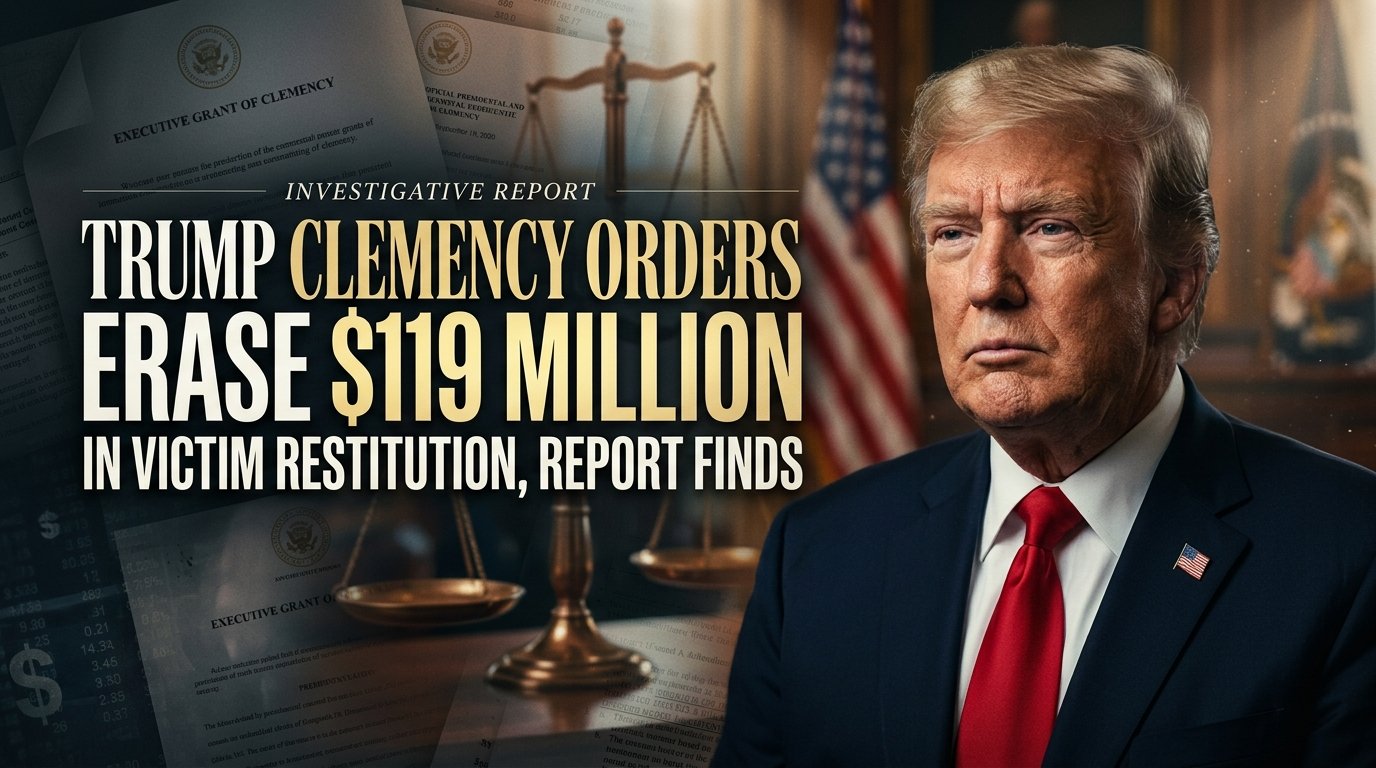
Presidential clemency decisions by Donald Trump have reportedly eliminated at least $119 million in unpaid court-ordered restitution to crime victims, according to a CBS News investigation. The findings have raised questions about how presidential pardons and commutations affect people seeking compensation after financial fraud.
The investigation examined more than 160 clemency orders issued between January 2025 and October 2026. It identified cases in which convicted individuals received presidential relief that removed outstanding restitution obligations.
The reported financial impact extends across several sectors, including small businesses, investors, financial institutions and individuals who lost money through fraud.
However, the figures require an important distinction. The reported $119 million represents unpaid restitution identified by the investigation, not the total financial losses suffered by every victim in the cases examined.
Trump Clemency Orders Raise Questions About Victims’ Rights
According to CBS News, its review found that Trump’s clemency decisions eliminated at least $119 million in outstanding restitution owed to crime victims.
The investigation also identified other financial penalties affected by clemency, including fines and amounts requested by prosecutors but not yet ordered by a judge.
These categories are legally different and should not be treated as interchangeable.
Restitution is intended to compensate victims for financial losses connected to a crime. Criminal fines, by contrast, generally go to the government rather than directly to the people harmed.
The U.S. Department of Justice explains that federal courts can order convicted offenders to reimburse victims for eligible losses. These may include lost income, damaged property and other costs directly connected to the offence. Source: U.S. Department of Justice — Restitution Process.
The reported findings have therefore renewed debate over how the clemency process balances mercy for convicted individuals with financial accountability to victims.
How Presidential Clemency Affects Financial Penalties
The U.S. Constitution gives the president broad authority to grant reprieves and pardons for federal offences. Presidential clemency includes several forms of relief, such as pardons, sentence commutations and remission of certain fines or penalties.
The precise legal effect depends on the type of relief granted and the terms of the clemency order.
According to Congress’s Constitution Annotated, the presidential clemency power encompasses commutations and the remission of fines or penalties. Source: Congress.gov — Pardon Power and Forms of Clemency.
For victims, the consequences can be significant when a criminal judgement is no longer enforceable in the same way.
Federal restitution orders can normally be enforced through mechanisms that allow the government to pursue eligible assets and income. The Justice Department says restitution judgements are generally enforceable for 20 years, subject to the applicable legal rules.
When an obligation is cancelled, victims may lose access to collection mechanisms tied to that judgement. Civil claims may remain possible, depending on the circumstances.
Carlos Watson Case Illustrates the Financial Impact
The case of Carlos Watson, the founder and former chief executive of Ozy Media, is one of the most prominent examples highlighted in the reporting.
In July 2024, a federal jury convicted Watson of conspiracy to commit securities fraud, conspiracy to commit wire fraud and aggravated identity theft. Prosecutors said he participated in a scheme involving false claims to investors and lenders.
In December 2024, a federal judge sentenced Watson to 116 months in prison.
The U.S. Attorney’s Office for the Eastern District of New York confirmed the conviction and sentence in an official announcement. Source: U.S. Department of Justice — Carlos Watson Sentencing.
Court records subsequently established a restitution judgement of approximately $36.77 million.
Trump granted Watson clemency in March 2025. The president’s official clemency list records the commutation and the restitution amount associated with Watson’s case. Source: U.S. Department of Justice — Presidential Clemency Records.
Thomas Franco, a private equity investor who invested nearly $4 million in Ozy Media, told CBS News that the decision left him feeling victimised again.
His experience highlights the difference between reducing a prison sentence and addressing the financial losses suffered by investors.
For people who invested money in a business based on allegedly false information, a criminal conviction may establish wrongdoing without guaranteeing that their losses will be recovered.
Small Businesses Also Faced Financial Losses
The CBS News investigation identified other cases in which clemency affected restitution owed to businesses.
Food manufacturers and the Camberos case
Andres and Adriana Camberos were convicted in connection with a scheme involving discounted products obtained from manufacturers and resold in the United States.
According to the investigation, a court ordered the siblings to pay approximately $48.8 million in restitution to affected companies.
The businesses included Mars-Wrigley and smaller food manufacturers. One was True Made Foods, a company founded by Abraham Kamarck.
CBS News reported that the siblings received clemency in January 2026
affecting their outstanding restitution obligations.
Kamarck told the news organisation that the alleged scheme hurt his company’s ability to compete and sell its products.
The case illustrates how financial fraud can affect smaller businesses that may have limited resources to absorb losses or pursue lengthy legal proceedings.
The White House defended the clemency decision, describing the prosecution as politically motivated. That characterisation represents the administration’s position, rather than an independently established finding.
Former nursing home executive Joseph Schwartz
Another case involved Joseph Schwartz, whose company, Skyline Healthcare, operated nursing homes in multiple states before collapsing in 2018.
According to CBS News, workers experienced problems involving health insurance premiums deducted from their pay cheques but not paid to insurers.
Schwartz was sentenced in 2025 to pay $5 million in restitution to the Internal Revenue Service, along with a $100,000 fine. The investigation reported that he paid the judgement before receiving a presidential pardon in November 2025.
Following the pardon, a federal judge approved his request to recover the money he had paid.
Theresa Dante, a former Skyline employee, told CBS News that the financial problems experienced by workers remained unresolved.
This case raises a difficult question about the consequences of returning previously paid penalties after clemency. While the defendant may receive financial relief, workers and other affected parties may still face unpaid bills and losses.
Investment Fraud Victims Face Continued Uncertainty
The investigation also examined cases involving investment fraud and losses suffered by individuals and organisations.
David Gentile, the former chief executive of GPB Capital Holdings, was convicted in connection with a major investment fraud case. Prosecutors alleged that investors were misled about the source of payments made by the firm.
Many investors had committed substantial sums, including retirement savings, to the investments.
Trump granted Gentile clemency in November 2025, according to the investigation. CBS News reported that the decision affected his outstanding restitution obligations.
The case highlights the challenges facing investors who may spend years trying to recover money after an investment scheme collapses.
Another case involved Jason Galanis and Devon Archer, who were among defendants convicted in connection with a scheme involving bonds issued by the Wakpamni Lake Community Corporation.
The defendants were ordered to repay more than $80 million collectively, according to CBS News. Trump granted clemency to both men in March 2025.
However, other defendants remained responsible for portions of the judgement. This meant that the financial consequences of clemency differed across the group.
These cases show why it is important to examine individual court judgements and clemency documents rather than assume that every victim’s claim disappears when one defendant receives relief.
Political Connections and Clemency Procedures Under Scrutiny
The reported financial effects have also prompted questions about access to the presidential clemency process.
CBS News reported that some recipients had connections to Trump’s political circle. In certain cases, attorneys or lobbyists with political relationships advocated for clemency, while campaign finance records documented donations by some recipients or their relatives to political organisations.
These circumstances have raised questions about transparency and equal access to presidential relief.
However, a political connection, donation or lobbying effort does not by itself prove that a clemency decision was improperly influenced.
The White House has defended the president’s constitutional authority to issue pardons and commutations and rejected the suggestion that paying lobbyists guarantees a favourable decision.
The U.S. Department of Justice maintains public records of presidential clemency grants. Those records provide a starting point for checking recipients, offences and the sentences listed in individual cases.
Readers can consult the official Trump clemency records published by the Department of Justice.
Can Victims Still Recover Money After Clemency?
Victims may retain legal options after a defendant receives clemency, but the available remedies depend on the case.
Civil litigation may be possible in some circumstances. However, filing a lawsuit can be costly, and a successful judgement does not guarantee payment if the defendant lacks sufficient assets.
The Department of Justice notes that full restitution is often difficult to collect because defendants may not have enough money or property to repay every victim. Payments may also be distributed over extended periods.
The department advises victims to consult their own attorneys about enforcement options and civil recovery. Source: U.S. Department of Justice — Restitution Process.
Consequently, eliminating a criminal restitution obligation can have serious financial implications. Victims may face additional legal expenses while trying to recover money that a court previously ordered a defendant to pay.
What the $119 Million Figure Does—and Does Not—Show
The reported $119 million figure represents outstanding, court-ordered restitution that CBS News identified as eliminated through clemency decisions.
It does not measure every loss suffered by victims in the cases examined.
The investigation also discussed fines, restitution sought by prosecutors before a final judicial order, and debts shared by multiple defendants. Those amounts have different legal statuses and should be assessed separately.
The distinction matters because a requested restitution amount is not necessarily a finalized court judgment. Likewise, canceling one defendant’s obligation does not automatically establish that every co-defendant’s responsibility has ended.
Even with those qualifications, the reported total points to a significant policy issue: presidential clemency can affect not only the punishment imposed on a convicted person but also the financial remedies available to those harmed by the crime.
Conclusion
The reported elimination of at least $119 million in unpaid restitution through Trump’s clemency decisions has intensified debate about the relationship between presidential mercy and financial accountability.
Cases involving Carlos Watson, food manufacturers, nursing home workers and investment fraud victims demonstrate the potential consequences for people and businesses seeking compensation.
The reported figures do not establish that every clemency decision was improper. They do, however, highlight the importance of transparent decision-making, accurate public records and careful consideration of victims’ financial interests.
Ultimately, the debate extends beyond prison sentences. It concerns whether people who lose money through criminal fraud have a realistic opportunity to recover their losses when the person convicted receives presidential relief.


