

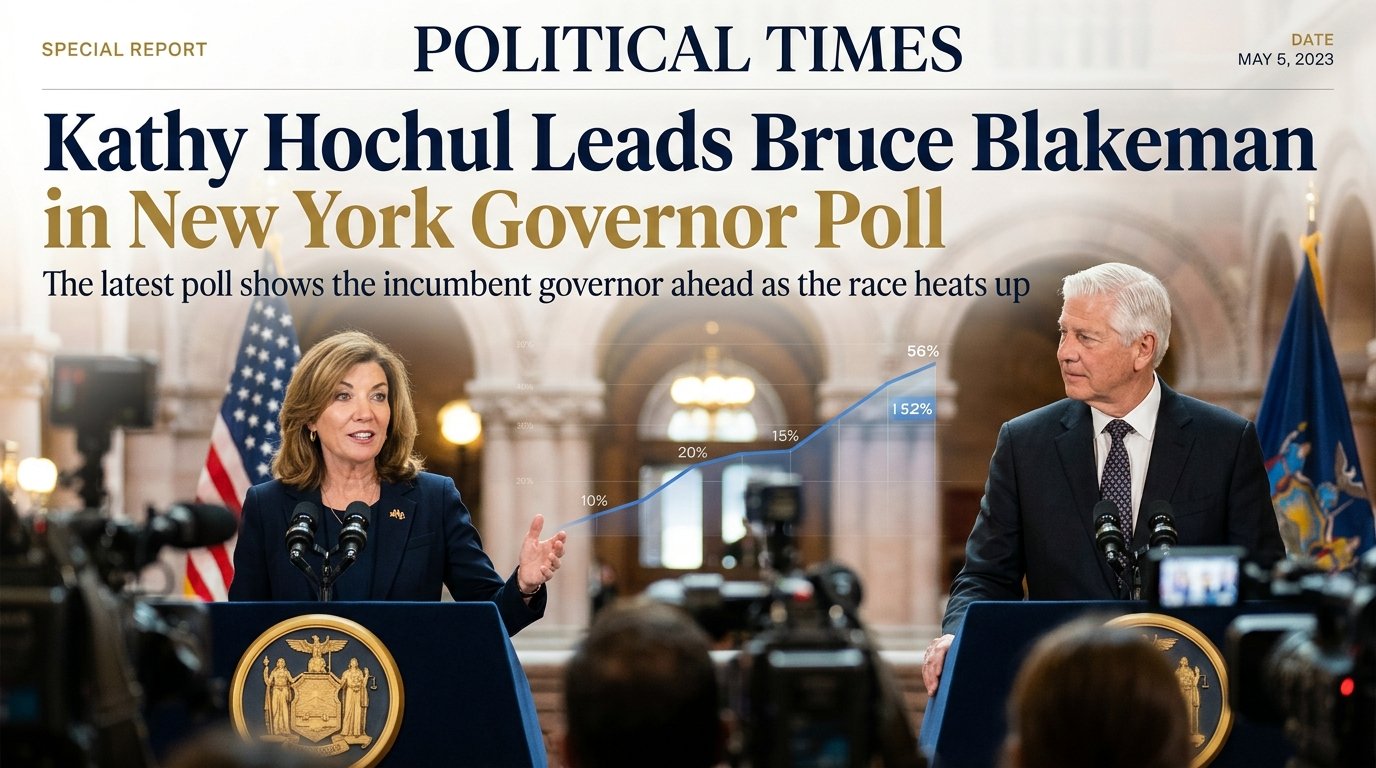
New York Gov. Kathy Hochul has expanded her lead over Republican challenger Bruce Blakeman, according to a new Siena Research Institute poll released on October 28, 2026. The latest survey gives Hochul a 54% to 40% advantage among likely voters, putting the Democratic incumbent ahead by 14 percentage points as Election Day approaches.
The findings mark an improvement for Hochul compared with Siena’s September survey, when she led Blakeman by nine points. The latest results also show stronger public ratings for the governor, although concerns about the cost of living remain a major issue for voters across New York.
According to the Siena Research Institute’s official poll release, the survey reflects responses from 807 likely voters and was conducted between October 19 and October 22.
Hochul Extends Her Lead in 2026 New York Governor Race
The latest Siena poll places Hochul in a stronger position heading into the final stretch of the 2026 New York gubernatorial election.
Hochul received support from 54% of likely voters, compared with 40% for Blakeman. Her lead increased from the 50% to 41% result recorded in September.
The growing gap suggests that Blakeman faces a difficult challenge in closing the distance before voters head to the polls. However, polling measures voter preferences at a particular time and does not guarantee the final election result.
Steven Greenberg, a pollster with the Siena Research Institute, said the widening margin presents a challenge for the Republican campaign. He also highlighted the importance of regional support and independent voters in determining whether a Republican candidate can compete statewide.
Independent Voters and Regional Support Remain Important
New York’s political geography creates a significant challenge for Republican candidates seeking statewide office.
Democrats benefit from a substantial voter-registration advantage and strong support in New York City. Republicans, meanwhile, generally need strong results in upstate communities and the downstate suburbs to remain competitive.
The latest Siena survey found Hochul ahead of Blakeman by 11 percentage points among independent voters. The candidates were much closer in upstate New York and the downstate suburbs.
These findings suggest that Blakeman has not established the clear regional advantages that Republicans typically need to overcome the Democratic registration edge.
Independent voters could therefore remain an important group as the campaign enters its final days.
Hochul’s Favorability and Job Approval Improve
The poll also recorded a notable improvement in how voters view Hochul.
For the first time in Siena polling during her five years as governor, a majority of likely voters gave her a favourable rating. Her favourability stood at 51%, while 45% viewed her unfavourably.
Her job approval rating also increased to 51%, up from 48% in September. The results indicate that more voters approve of her performance in office than in the previous survey.
Blakeman’s favourability numbers were more closely divided. The Republican challenger received a favourable rating of 39%, while 40% viewed him unfavourably.
These figures measure voters’ perceptions of the candidates rather than their direct voting intentions. Nevertheless, favourability and job approval can help explain the broader political environment surrounding a campaign.
Cost of Living Remains a Major Concern for New York Voters
Despite Hochul’s polling advantage, the survey revealed continuing uncertainty about whether either candidate could make everyday life more affordable.
According to the Siena findings, 35% of likely voters said neither candidate would make life more affordable. Meanwhile, 30% selected Hochul, and 27% chose Blakeman.
The results show that affordability remains a significant issue for voters, even as the candidates compete for support in the final stretch of the race.
For Hochul, a stronger overall polling position does not necessarily mean voters are satisfied with the state’s economic conditions. For Blakeman, the figures suggest that economic concerns alone have not yet translated into a polling lead.
The affordability question may remain important for voters weighing the candidates’ records, proposals and potential priorities.
Poll Shows Differences Across Voter Groups
The Siena survey also found differences in support based on gender and race.
Hochul led Blakeman by 23 percentage points among women and six points among men. Among Black voters, she held a substantial advantage, receiving 81% support compared with 16% for Blakeman. White voters were more closely divided.
These results illustrate the different levels of support the candidates receive across demographic groups. However, subgroup estimates should be interpreted carefully because their sample sizes are smaller than the survey’s overall sample.
The poll also measured voters’ expectations about the election outcome. Some 68% believed Hochul would win, while 23% expected Blakeman to prevail.
Notably, 40% of Republican respondents also predicted a Hochul victory. These figures reflect expectations about the likely winner, not necessarily each respondent’s personal voting choice.
Other New York Statewide Races Show Democratic Leads
The Siena poll also examined two other statewide contests and found Democratic candidates leading their Republican opponents.
Democratic Attorney General Letitia James led Republican challenger Saritha Komatireddy by 54% to 39%. Meanwhile, Democratic State Comptroller Tom DiNapoli held a 59% to 32% advantage over Republican Joseph Hernandez.
The results suggest that Democratic candidates have substantial polling leads across several statewide contests. Still, the final outcomes will depend on turnout, voter decisions and developments before Election Day.
What the Siena Poll Means for the Governor’s Election
The latest survey gives Hochul a clear polling advantage over Blakeman, with her lead growing since September. Her improved favourability and job approval figures add to the positive picture for the incumbent.
However, the findings also reveal issues that remain unresolved. Affordability continues to concern voters, and the race remains more competitive in some regions than the statewide figures suggest.
The poll offers a snapshot of voter sentiment rather than a prediction with a guaranteed outcome. Its findings should be considered alongside other surveys, campaign developments and turnout patterns.
Siena Poll Methodology
The Siena Research Institute conducted the survey from October 19 through October 22, 2026. Researchers surveyed 807 likely voters in New York using telephone interviews and text-to-web responses.
The poll has a reported margin of error of plus or minus 4.1 percentage points, including the effects of weighting. As with any political survey, its results may also be affected by factors that a margin of error does not capture.
Readers can review the full results and methodology in the official Siena Research Institute release.


