

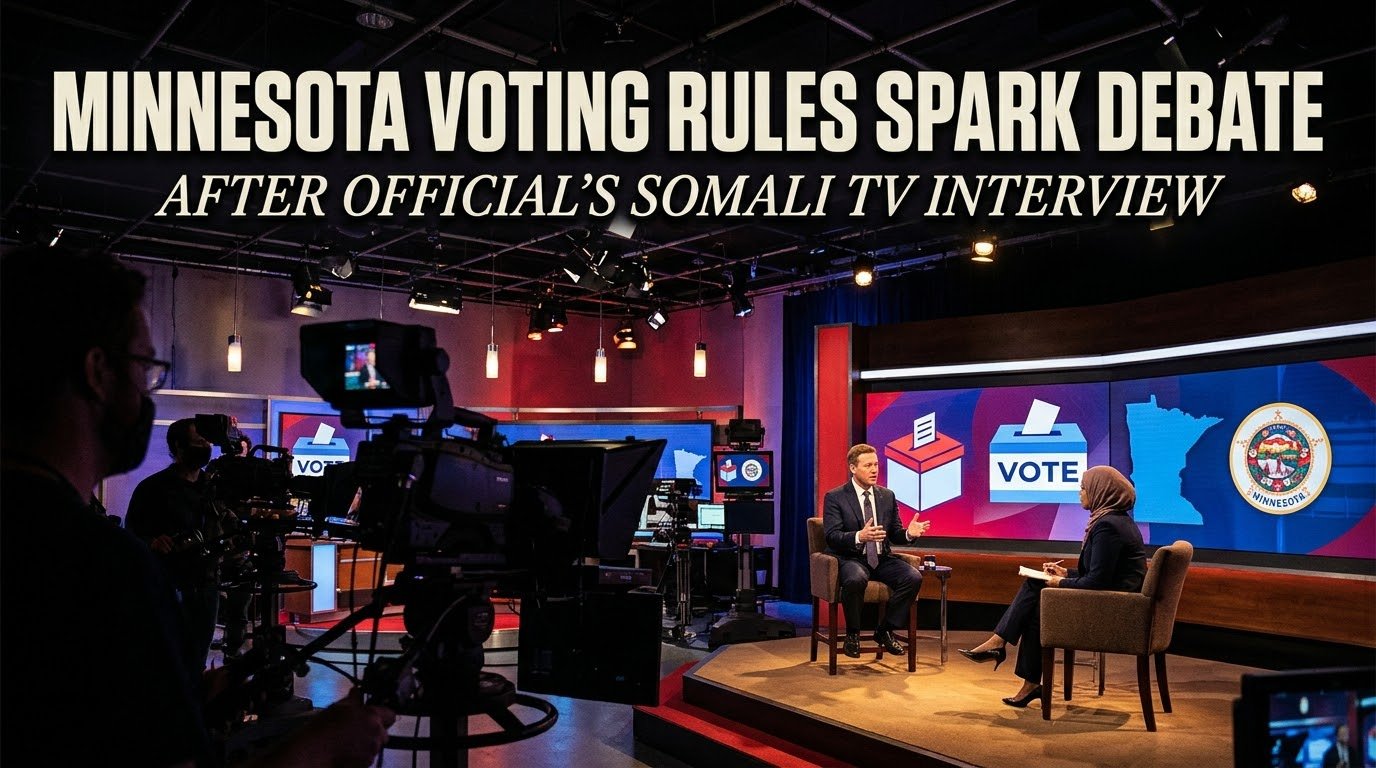
Minnesota voting rules have become a subject of renewed political debate after a state election official explained voter registration procedures during an interview with Somali TV of Minnesota. The comments have triggered criticism on social media, particularly over voter identification requirements and same-day registration.
Melanie Hazelip, Minnesota’s voter outreach director, appeared on the local television programme on October 26, 2026. During the interview, she explained that registered voters do not need to present identification when they arrive to vote. She also discussed the documents and alternative procedures available to people registering on Election Day.
A video of the interview circulated widely online, prompting questions about election security and whether Minnesota’s procedures provide sufficient safeguards against ineligible voting.
However, Minnesota law clearly requires voters to be U.S. citizens. The state’s election office has also defended Hazelip’s comments, describing them as accurate information about existing voting procedures.
Why Minnesota Voting Rules Are Facing New Scrutiny
The controversy began after conservative social media accounts shared clips from Hazelip’s television appearance.
In the interview, she explained that people who are already registered can arrive at an early voting location without bringing identification.
She also discussed same-day registration. Under Minnesota law, eligible residents can register and vote on the same day by providing acceptable proof of residence or using an approved alternative.
The video quickly attracted attention from political commentators and election integrity advocates.
Some critics argued that the interview did not place enough emphasis on the citizenship requirement. Others questioned whether the state’s identification procedures could make it easier for ineligible individuals to attempt to vote.
However, the discussion has also raised concerns about misleading interpretations of Minnesota’s election laws.
The rules described by Hazelip apply to eligible voters throughout the state. They do not create separate voting privileges for Somali residents or any other ethnic community.
What Did Minnesota Election Official Melanie Hazelip Say?
Hazelip’s October 26 appearance focused on explaining how residents can participate in early voting and register when they arrive at a polling location.
She made two important points.
First, voters who have already completed registration generally do not need to show identification when casting their ballots.
Second, people who have not registered still have options. They can use an accepted Minnesota identification document or another approved method to establish their residence.
Her comments were intended to explain the state’s existing registration procedures.
The Minnesota Secretary of State’s office later defended the interview in a statement to Fox News Digital.
The office said its staff regularly provide election information to hundreds of nonpartisan community organisations.
It also described Hazelip’s remarks as accurate explanations of Minnesota election laws and said political commentators had misrepresented them online.
The office added that its priority remained helping eligible residents understand how and where to vote.
Does Minnesota Require Voters to Be U.S. Citizens?
Yes. Citizenship is a legal requirement for voting in Minnesota elections.
According to the Minnesota Secretary of State’s official website, anyone registering to vote must meet several eligibility conditions.
These include:
- Being a United States citizen.
- Being at least 18 years old on Election Day.
- Living in Minnesota for at least 20 days before the election.
- Meeting the state’s other legal voting requirements.
Green card holders and other noncitizens cannot legally vote in Minnesota elections.
The citizenship requirement applies to local, state and federal elections.
Knowingly voting while legally ineligible is also a felony under Minnesota law.
This distinction is important because having a Minnesota driver’s licence or state identification card does not automatically make someone eligible to vote.
Why Can Registered Minnesota Voters Vote Without Showing ID?
Minnesota does not generally require already-registered voters to present photo identification at the polling place.
Election officials use the existing voter registration record to confirm the person’s eligibility and registration details.
This is different from allowing someone to vote without meeting the legal requirements.
A registered voter must still be eligible under state law. The absence of a photo ID requirement at the polling place does not remove the citizenship requirement.
Minnesota also provides procedures for people who need to update their registration or register on Election Day.
How Does Same-Day Voter Registration Work in Minnesota?
Minnesota allows eligible residents to register at their polling place on Election Day.
The procedure is designed to help people who missed the advance registration deadline or recently moved.
However, applicants must establish their Minnesota residence through an approved method.
The Secretary of State lists several options, including:
1. Minnesota Identification Documents
An eligible applicant can use a current Minnesota driver’s licence, learner’s permit or state identification card showing their current address.
Other acceptable documents may also be used under state rules.
2. Supporting Documents
People without an appropriate photo ID can use certain documents that establish their residence.
The state provides a list of acceptable documents and combinations of documents on its official election website.
3. Vouching by a Registered Voter
Another option is voter vouching.
A registered voter from the applicant’s precinct can accompany the person to the polling place and sign an oath confirming their residence.
Under Minnesota rules, one registered voter can vouch for up to eight other voters.
Importantly, this procedure confirms residence. It does not remove the citizenship requirement or authorise a noncitizen to vote.
Why Are Minnesota’s Driver’s License Rules Part of the Debate?
Another issue attracting attention is Minnesota’s Driver’s Licenses for All law.
The policy, signed by Governor Tim Walz in 2023, allows eligible residents to obtain driver’s licences regardless of their immigration status.
As a result, some Minnesota driver’s licences and identification cards can be issued to non-citizens.
Critics argue that these documents can create confusion because they do not necessarily establish citizenship.
However, possessing a state-issued identification card is not the same as being eligible to vote.
Minnesota’s voter registration process includes separate eligibility requirements.
The state also introduced automatic voter registration in 2024. According to the Secretary of State, the system uses citizenship-affirming documentation and other eligibility checks before registering someone through the driver’s licence or state identification process.
Therefore, receiving a driver’s licence does not automatically grant a noncitizen the right to vote.
Political Critics Question the Timing of the Interview
The television appearance has attracted criticism from several conservative commentators.
Retired Navy intelligence officer Phillip C. Parrish questioned the state’s approach to voter identification and same-day registration in a post on X.
Federalist Society co-founder David McIntosh also criticised the interview, arguing that the explanation could encourage improper voting.
Other conservative commentators raised concerns about the state’s voter verification procedures and called for stronger election safeguards.
Bill Glahn, a policy fellow at the Center of the American Experiment, told Fox News Digital that Hazelip should have emphasised the citizenship requirement more clearly, given the audience and the timing of the interview.
These comments reflect political criticism of Minnesota’s election procedures. They do not establish that noncitizens voted illegally as a result of the interview.
Minnesota Secretary of State Defends Its Voter Outreach Programme
The Minnesota Secretary of State’s office rejected the suggestion that Hazelip’s comments represented an effort to weaken election safeguards.
In its statement to Fox News Digital, the office said voter outreach is a regular part of its work.
Officials explained that the department provides information to community organisations so eligible residents understand how to register and cast ballots.
The office also criticised the way the video was presented on social media.
According to the statement, Hazelip accurately described the state’s existing election laws, but political accounts had misinterpreted her remarks.
The response highlights the disagreement between state election officials and critics over how Minnesota’s voting procedures should be explained to the public.
What Happens Next in Minnesota’s Election Debate?
The controversy comes at a politically sensitive time, with the election approaching.
Questions about voter identification, citizenship verification and same-day registration are likely to remain part of the wider national election debate.
For now, Minnesota’s existing rules remain in effect.
U.S. citizenship is mandatory for voting. Registered voters generally do not need to present identification at the polling place, while new registrants must follow approved procedures to establish their residence and meet eligibility requirements.
The central issue is therefore not whether Minnesota allows noncitizens to vote. State law prohibits it.
Instead, the debate concerns whether the current verification procedures provide enough public confidence and whether election officials should explain citizenship requirements more prominently during voter outreach.


