

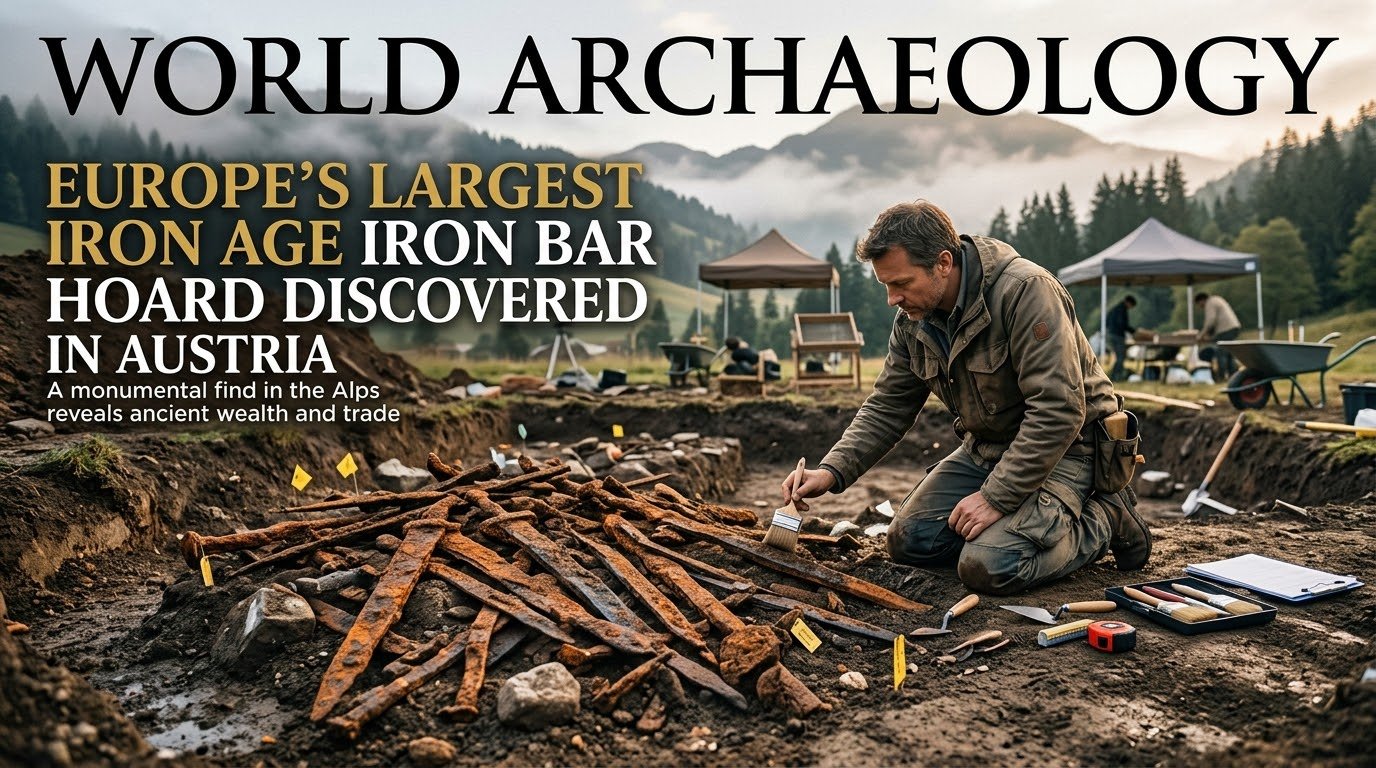
Archaeologists have identified an extraordinary collection of ancient iron bars in Upper Austria, revealing new evidence about metal production and trade in prehistoric Europe. The discovery, made near the Danube River, contains at least 500 iron bars weighing more than one metric tonne.
Researchers believe the valuable cargo may have ended up underwater following a shipwreck more than 2,000 years ago. If this interpretation is correct, the discovery offers a rare glimpse into the scale of commercial transportation during the European Iron Age.
The findings were published in September 2026 in the archaeological journal Antiquity. The research was conducted by Peter Trebsche of the University of Innsbruck and archaeologist Marion Berranger.
Archaeologists Identify Europe’s Largest Iron Age Iron Bar Hoard
The remarkable collection was recovered at Deinham, a location in the municipality of Hartkirchen in Upper Austria. Researchers now consider it the largest known assemblage of prehistoric iron bars discovered in Europe.
The objects first came to light in 2019 when workers were extracting gravel from an area close to the Danube. During the operation, their equipment brought several unusual, heavily rusted metal objects to the surface.
Rather than treating the material as ordinary scrap metal, the workers reported the discovery to Austria’s Federal Monuments Office.
Their decision allowed specialists to investigate and preserve an archaeological collection of exceptional importance.
According to the published research, archaeologists documented 540 iron fragments. After examining and matching the pieces, they established that the collection represents at least 500 individual iron bars.
The objects were subsequently donated to a state museum collection in 2023.
How Old Are the Ancient Iron Bars?
Radiocarbon dating and archaeological analysis helped researchers establish the age of the collection.
The iron bars belong to the La Tène period, a significant phase of the European Iron Age associated with Celtic communities and expanding metal production.
The researchers place the discovery broadly within the third to second centuries BC, although the wider La Tène period extended across several centuries.
The bars have an unusual shape. They are pointed at both ends and have been classified as bipyramidal iron bars.
These objects were not finished products. Instead, they were iron semi-products intended for further processing by metalworkers.
Their discovery is particularly valuable because ancient iron objects can be difficult to date and are sometimes overlooked during archaeological investigations.
Could the Iron Bars Have Come From an Ancient Shipwreck?
One of the most intriguing aspects of the discovery is its location.
The collection was recovered from an old, silt-filled channel of the Danube River. This suggests that the objects may have entered the water during an ancient transportation accident.
Lead researcher Peter Trebsche considers a shipwreck the most plausible explanation for their presence.
However, archaeologists have not recovered any remains of a vessel. Therefore, the shipwreck theory remains an interpretation rather than a confirmed fact.
The surrounding river environment offers some support for the hypothesis. Historical records and geographical investigations indicate that this stretch of the Danube contained sandbanks and large stones that could have created serious navigation difficulties.
Researchers also found no clear evidence that the iron bars had been deliberately destroyed or deposited as part of a ritual offering.
Together, these observations make accidental loss during transportation a convincing possibility.
One Tonne of Iron Could Have Produced Around 500 Swords
The sheer quantity of metal makes the Deinham discovery particularly significant.
Researchers estimate that the recovered iron bars had a combined weight of approximately 1,035 kilograms, or just over one metric tonne.
To understand the scale of this ancient cargo, the researchers calculated how much could have been manufactured from the available material.
Their estimates suggest that the iron could have produced approximately 500 swords, each weighing around 1.5 to 2 kilograms.
Another possible use was the production of thousands of iron nails. The research estimates that the material could have supplied approximately 8,000 nails.
These figures illustrate the potential economic and practical importance of the collection.
However, they do not establish what the original buyers intended to manufacture. The iron could have been processed into different weapons, tools or other metal products.
Where Did the Iron Come From?
The original production location and intended destination of the cargo remain uncertain.
Nevertheless, researchers consider Bavaria in southern Germany a likely source.
The region contains evidence of Iron Age iron production, including sites associated with large fortified settlements known as oppida.
The archaeological team has identified similarities between the Deinham bars and examples previously discovered in parts of Bavaria and nearby regions.
This provides a possible geographical connection, although the exact origin has not yet been established.
Further scientific investigations could help resolve the question.
Researchers are conducting additional analyses to examine the metal’s composition and production characteristics. These studies may reveal where the iron originated and whether the bars were manufactured in one workshop or several production centres.
What the Discovery Reveals About Iron Age Trade
The Deinham collection offers important evidence about the development of large-scale iron production in prehistoric Europe.
During the La Tène period, iron became increasingly important for manufacturing weapons, agricultural equipment, construction materials and everyday tools.
Archaeologists have long known that specialised production centres existed. However, determining the actual volume of ancient iron production and long-distance trade has been challenging.
The problem is partly related to preservation. Iron corrodes over time, and unfinished metal products can be difficult to recognise during excavation.
The discovery of more than 500 iron bars in one location provides unusually strong evidence of the quantities that could be gathered and transported during this period.
It also suggests that inland waterways such as the Danube played an important role in moving valuable materials between different communities.
According to the researchers, the scale of the Deinham cargo demonstrates the growing production capacity of the Danube region during the third and second centuries BC.
Why the Deinham Discovery Matters to Archaeology
The importance of the discovery extends beyond the number of recovered objects.
It provides researchers with an opportunity to study the organisation of ancient metal production, the movement of raw materials and the economic relationships between prehistoric communities.
The collection also highlights how easily significant archaeological evidence can be lost.
Because the iron objects initially appeared as heavily corroded material, they could have been mistaken for ordinary scrap metal. Reporting the discovery to the authorities made detailed archaeological investigation possible.
For researchers studying the European Iron Age, the Deinham find is therefore an unusually valuable source of information.
Although questions about its original production site, destination and possible shipwreck remain unanswered, further analysis may reveal more about the trade networks that connected communities along the Danube more than two millennia ago.


