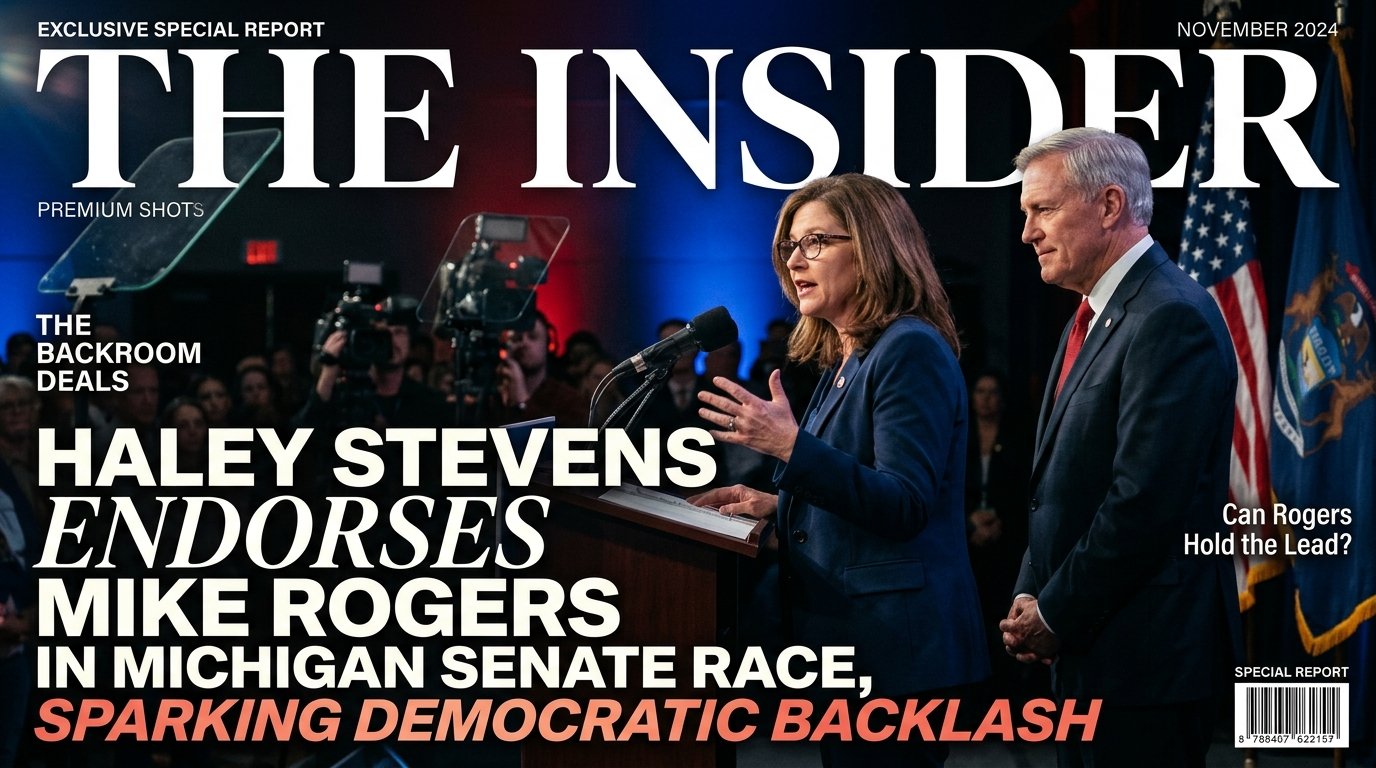
Michigan’s closely watched Senate race has taken an unexpected turn after Democratic Rep. Haley Stevens endorsed Republican candidate Mike Rogers just two days before Election Day. Her decision marks a major break with her party’s nominee, Abdul El-Sayed, and has triggered strong reactions from Democratic leaders. Stevens announced her support for Rogers on Sunday, November 1, following a public appearance with the Republican candidate at Perfecting Church in Detroit. The endorsement came after days of growing tension between Stevens and El-Sayed, who defeated her in Michigan’s Democratic Senate primary in August. The move has added another layer of uncertainty to an already competitive Senate contest, which could play an important role in determining control of the U.S. Senate.
Why Haley Stevens Endorsed Mike Rogers
Stevens explained her decision in a video shared on social media. She said El-Sayed had made it clear that she was no longer welcome in his campaign and should stay away. She used that disagreement to explain why she had decided to support his Republican opponent instead. The congresswoman also pointed to concerns about El-Sayed’s political associations and his response to a controversial advertisement connected to the ongoing debate over U.S. support for Israel.
One major source of disagreement involved an advertisement produced by the outside group Rebellion PAC. The ad connected the rising cost of groceries in the United States with American military assistance to Israel and the war in Gaza. Stevens criticised the advertisement and described its message as antisemitic. She called on El-Sayed to publicly condemn it. El-Sayed, however, said his campaign did not create the advertisement and made clear that he disagreed with its contents. He also criticised Stevens for continuing disputes from the Democratic primary instead of focusing on the general election.
Stevens has also raised concerns about El-Sayed’s association with political commentator Hasan Piker, whose remarks have generated controversy. Despite the disagreement, Stevens maintained that she remains a Democrat. She described her endorsement as a personal decision rather than a rejection of the Democratic Party as a whole.
Mike Rogers Welcomes Stevens’ Endorsement
Rogers welcomed the congresswoman’s decision and said he was honoured to receive her support. The Republican candidate appeared alongside Stevens at the Detroit church service on Sunday. He later told reporters that their decision to appear together followed a phone conversation earlier that morning. Rogers presented the endorsement as a message about opposing hate and working toward a better future for Michigan and the country. The endorsement also gives Rogers an opportunity to appeal to voters who supported Stevens during the Democratic primary. Stevens narrowly lost that contest to El-Sayed in August. Her support for Rogers could therefore become a talking point for Republicans seeking to attract moderate Democrats and independent voters. However, the endorsement does not establish how those voters will respond at the ballot box.
Stevens’ announcement quickly drew criticism from prominent Democrats, including Senate Minority Leader Chuck Schumer and Michigan Rep. Debbie Dingell. Schumer, who had supported Stevens during the Democratic primary, strongly reaffirmed his support for El-Sayed. He argued that the Democratic nominee would better represent the economic interests of working families in Michigan. He also described Stevens’ endorsement as a betrayal of her party. Dingell urged Michigan voters to focus on issues such as affordability and the economic challenges facing working families. She said the internal dispute was distracting from the important issues in the Senate campaign. Michigan Democratic Party Chair Curtis Hertel also responded sharply. He stated that Stevens was no longer a member of the Michigan Democratic Party and would not be one in the future.
Meanwhile, President Donald Trump praised Stevens for backing Rogers. Trump described her endorsement as a significant political move and expressed confidence in its importance to Michigan voters. House Speaker Mike Johnson also voiced support for Stevens, saying he had spoken with her following the announcement. The contrasting reactions highlight the growing political divide surrounding the Michigan Senate contest. The endorsement has also created turmoil within Stevens’ political team. Her long-time chief of staff, Justin German, announced his departure following her decision to support Rogers. In a statement, German said he and other members of the team were shocked and disappointed by the endorsement. He also confirmed that he and his colleagues continued to support El-Sayed in the Senate race.
Other members of Stevens’ communications team also indicated that they were leaving her office. Former press secretary and campaign spokesperson Joetta Appiah criticised the congresswoman’s decision, arguing that it contradicted the values her campaign had previously promoted. The departures add to the political fallout surrounding Stevens’ announcement and demonstrate how deeply her decision has affected her political circle.
Abdul El-Sayed Keeps Focus on Michigan Voters
El-Sayed has attempted to move the conversation away from his dispute with Stevens and back toward the issues affecting Michigan residents. Responding to the endorsement, he said he was more concerned about the needs of ordinary people across the state than about the disagreement involving two political figures. His campaign has continued to emphasise economic affordability, healthcare, education and the cost of living. El-Sayed is competing against Rogers for Michigan’s open U.S. Senate seat following Democratic Sen. Gary Peters’ retirement.
The November 3 election is particularly important because the outcome could influence the balance of power in Washington. For Rogers, Stevens’ endorsement offers an opportunity to strengthen his appeal among voters outside the traditional Republican base. For El-Sayed, the challenge is to maintain Democratic support while keeping the campaign focused on his policy priorities. With Election Day approaching, the impact of Stevens’ unexpected endorsement remains uncertain. What is clear, however, is that the disagreement has exposed significant divisions among Michigan Democrats at a critical moment in the Senate campaign.