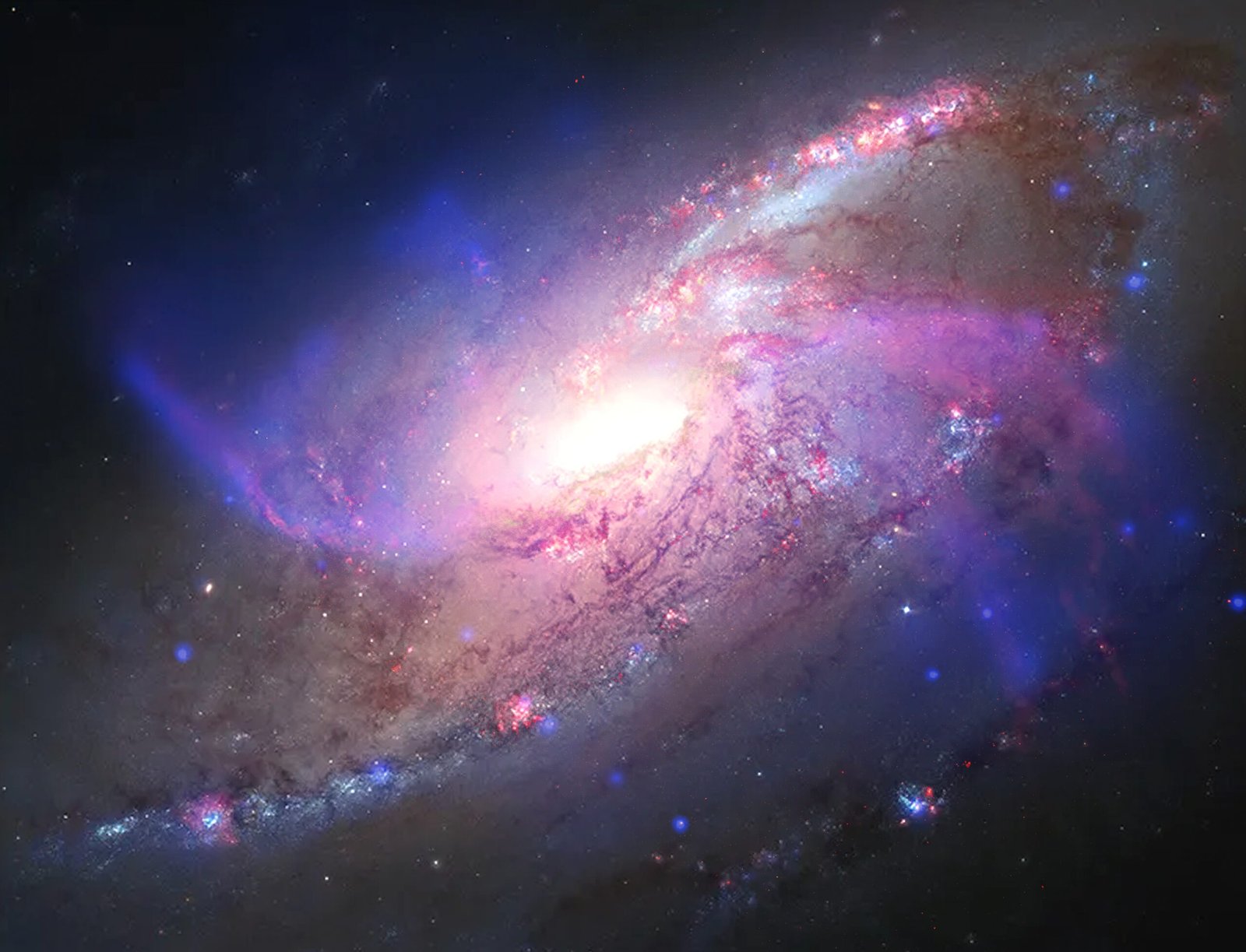
Chandra Gallery Shows Galaxies in X-Ray and Other Light
NASA’s Chandra X-ray Observatory has released a new collection of galaxy images that combines X-ray observations with data from other space and ground-based telescopes. The gallery gives scientists and the public a multiwavelength view of the processes shaping galaxies across the universe.
Sixteen galaxies, many different stories
The new gallery includes 16 images representing spiral, elliptical, and irregular galaxies. Each category reflects different structures and evolutionary histories, but no single wavelength can capture everything happening inside a galaxy.
Chandra observes X-rays, which are produced by extremely hot gas and energetic objects. When those observations are combined with optical, infrared, ultraviolet, or radio data, astronomers can study both the visible structure of a galaxy and the high-energy processes taking place around stars and black holes.
Black holes leave visible fingerprints
One example highlighted by the gallery is NGC 4258, a spiral galaxy with unusual additional arms made of hot gas. Chandra observations reveal superheated material associated with jets from the galaxy’s central black hole. Other telescopes show the galaxy’s stars, dust, and cooler structures.
These observations help scientists understand how supermassive black holes can influence their host galaxies. Black-hole jets can inject energy into surrounding gas, affecting how that gas cools and potentially influencing future star formation.
Star formation is also part of the picture
Other galaxies in the collection show regions where stars are forming rapidly. X-ray observations can reveal hot gas produced by stellar winds and supernova explosions, while optical and infrared instruments trace the stars, dust, and molecular material involved in the broader process.
This multiwavelength approach is particularly useful for comparing galaxies with different histories. Astronomers can examine how gas moves, how stars form, and how energetic objects influence galactic environments.
Why X-rays add something different
Human eyes see only a small portion of the electromagnetic spectrum. X-rays reveal energetic processes that are invisible in ordinary optical images. Chandra therefore provides a different layer of information about the universe, including evidence of superheated gas, black-hole activity, neutron stars, and other high-energy sources.
The new gallery also demonstrates why astronomical images are scientific tools rather than simply attractive pictures. Each color or wavelength can represent a different physical measurement. Scientists interpret those measurements together to understand how structures evolve.
Long missions create lasting science
Chandra has spent decades collecting X-ray data. That long archive allows researchers to revisit observations and combine them with newer measurements from missions such as Webb, Hubble, IXPE, Swift, and NuSTAR.
The result is a more complete record of galactic evolution. As new instruments provide different observations, older Chandra data can gain additional value because the same galaxies can be examined through multiple scientific perspectives.
Sources and related reporting
Hudson Tribune readers can explore the Science section, Technology section, World section, U.S. News section, Health section, and the Newsroom.
Sources include NASA Chandra Science, Chandra X-ray Observatory, NASA Hubble, NASA Webb, NASA IXPE, and NASA Galaxy Science.