

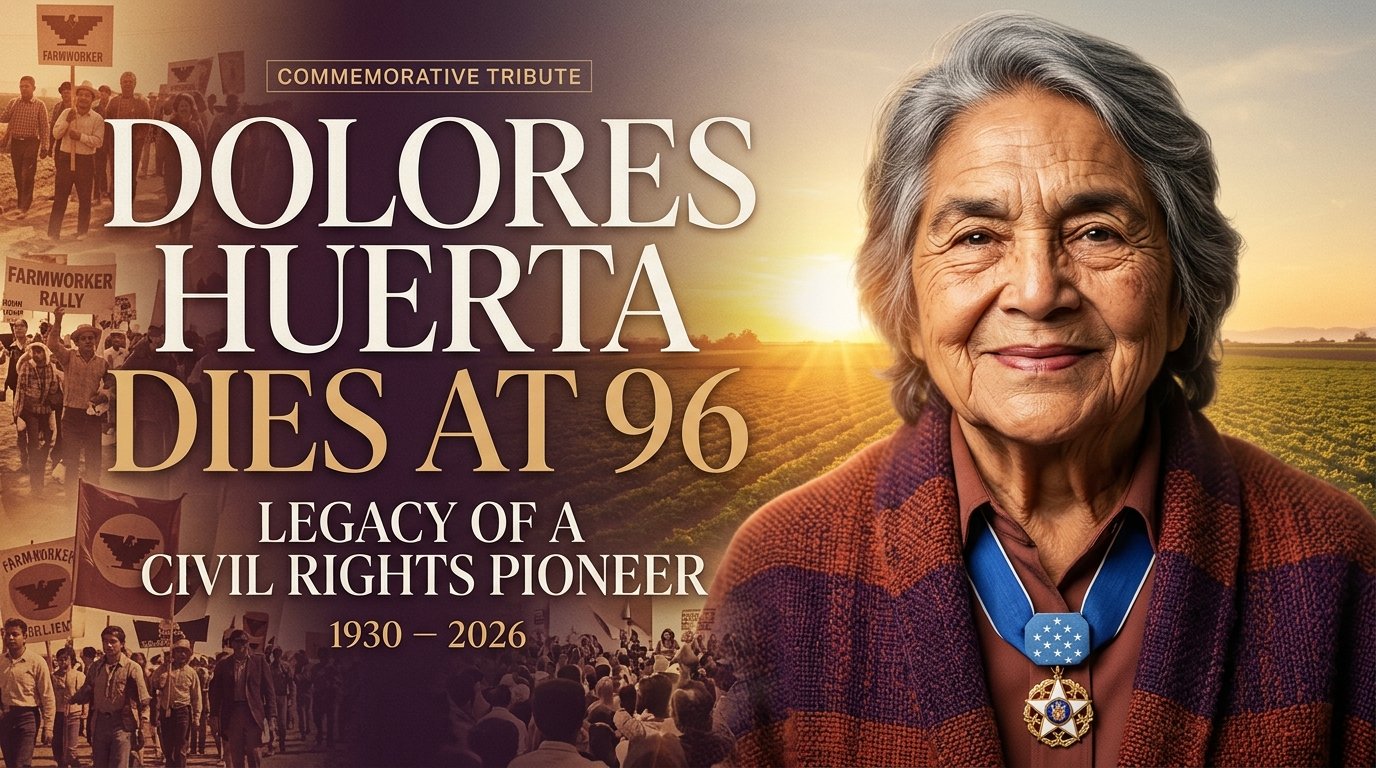
Dolores Huerta, the celebrated American labour organiser and civil rights activist who helped transform the farmworkers’ rights movement, has died at the age of 96. Her family announced her death on October 28, 2026, saying she passed away at home.
Huerta devoted decades to improving conditions for agricultural workers and advancing equality for women, immigrants and marginalised communities. As a co-founder of the organisation that became the United Farm Workers (UFW), she helped bring national attention to the challenges faced by farmworkers across the United States.
Her influence extended well beyond labour organising. The slogan “Sí, se puede”, meaning “Yes, it can be done”, became a widely recognised expression of determination and collective action. Her contributions to American public life earned her numerous honours, including the Presidential Medal of Freedom in 2012. Source: U.S. Department of Labour
Dolores Huerta’s Family Announces Her Death at 96
Huerta’s family shared the news through the Dolores Huerta Foundation, asking the public to respect their privacy while they mourned.
The announcement prompted renewed attention to her extraordinary life and the causes she championed. Even in her later years, Huerta remained engaged in public advocacy, speaking about social justice, women’s rights and economic inequality.
Rather than retiring from activism, she continued to encourage communities to organise, participate in civic life and demand accountability from public officials.
Further details about memorial services and plans to honour her life should be confirmed through official family or foundation announcements.
Who Was Dolores Huerta? A Life Dedicated to Social Justice
Born Dolores Clara Fernández Huerta on April 10, 1930, in Dawson, New Mexico, Huerta grew up in Stockton, California, after moving there with her mother and brothers.
Her early experiences helped shape her commitment to working families. Her mother, Alicia Chávez, supported the family while building a business and maintaining strong connections with the local community.
Huerta later became a schoolteacher. However, witnessing the hardship experienced by children from farmworker families changed the direction of her career.
She came to believe that organising agricultural workers could address some of the deeper problems affecting their families, including poverty, poor working conditions and limited access to essential services.
That decision marked the beginning of a career that would make her one of the most influential figures in the American labour movement.
How Dolores Huerta Helped Build the United Farm Workers
In 1962, Huerta joined César Chávez and other organisers in establishing the National Farm Workers Association. The organisation later became part of the United Farm Workers of America.
At the time, many agricultural labourers faced low wages, difficult working conditions and limited bargaining power. Organising workers across a large and often fragmented industry presented a major challenge.
Huerta became a central figure in addressing those problems. She organised workers, negotiated with agricultural employers and helped build public support for labour reform.
The Delano Grape Strike and National Boycotts
One of the defining campaigns of the farmworkers’ movement was the Delano grape strike, which began in California in 1965. Filipino farmworkers initiated the strike, and Huerta and other organisers helped bring additional support to the effort.
The campaign developed into a broader struggle involving workers, unions, consumers and civil rights supporters. National grape boycotts increased pressure on growers to negotiate with farmworker representatives.
These efforts contributed to important advances in collective bargaining and working conditions. Huerta also helped secure labour protections and benefits for agricultural workers.
The movement demonstrated how organised workers and public solidarity could influence an industry with considerable economic and political power.
What Does “Sí, se puede” Mean?
“Sí, se puede” translates from Spanish as “Yes, it can be done.” The phrase became closely associated with Huerta’s approach to organising and her belief in the power of collective action.
Its message was straightforward: ordinary people could challenge unfair systems when they worked together and remained committed to their goals.
Over time, the slogan reached audiences far beyond farmworker communities. It became a rallying cry for political campaigns and social justice movements, reflecting Huerta’s lasting influence on American activism.
Her legacy includes not only specific labour achievements but also a powerful message about participation, persistence and the possibility of social change.
Dolores Huerta’s Work for Women’s Rights and Political Representation
Huerta’s activism extended beyond agricultural labour. She worked to expand opportunities for women, encourage Latino voters to participate in elections and increase representation for women and Latinos in public office.
She also advocated for immigrant rights, safer workplaces and stronger protections for disadvantaged communities.
Her political organising included voter registration and efforts to influence legislation affecting working families. Through these activities, she connected workplace concerns with wider questions about representation, economic security and civil rights.
In 2003, Huerta established the Dolores Huerta Foundation to support community organising and develop local leaders. The foundation continued the work of building civic participation and advancing social justice.
Her career helped demonstrate that labour rights, women’s equality and political engagement were closely connected.
Presidential Medal of Freedom and Other Honours
Huerta received major recognition for her decades of public service.
In 2012, President Barack Obama awarded her the Presidential Medal of Freedom, the highest civilian honour in the United States. The award recognised her longstanding work on behalf of workers and underserved communities.
She was also inducted into the National Women’s Hall of Fame in 1993, becoming the first Latina to receive that distinction.
Her contributions have been recognised by educational institutions, civic organisations and labour groups. Schools, murals and public spaces bearing her name reflect the reach of her influence across generations.
These honours acknowledged an activist whose work helped bring farmworkers’ concerns into national discussions about justice and equality.
Dolores Huerta’s Legacy Amid New Scrutiny of César Chávez
Huerta’s legacy also became part of a difficult public discussion in 2026 following her disclosure of alleged sexual abuse by César Chávez, her long-time collaborator in the farmworkers’ movement.
In March 2026, Huerta publicly described sexual encounters with Chávez that she said were nonconsensual. She explained that she had remained silent for decades because she feared the disclosure would harm the movement she had helped build.
The allegations emerged alongside wider reporting about accusations of sexual abuse against Chávez. The revelations prompted renewed debate about how the history of the farmworkers’ movement should be understood and commemorated.
These developments added a painful dimension to the history of two prominent figures associated with labour organising. They also underscored the importance of listening to survivors while examining historical leaders and institutions critically.
Huerta’s contributions to farmworker organising and civil rights remain significant in their own right. Understanding her life means recognising both the achievements of the movement and the difficult questions that have emerged about its history.
Remembering Dolores Huerta’s Impact on America
Dolores Huerta’s death marks the passing of a major figure in the struggle for workers’ rights and social equality.
Her influence can be seen in the labour protections she helped advance, the organising methods she championed and the generations of activists inspired by her example.
She helped demonstrate that people with limited resources could challenge powerful institutions through sustained organising, negotiation and public pressure.
Her work also broadened the understanding of civil rights by connecting economic justice with women’s equality, immigrant rights and democratic participation.
As tributes follow her death, Huerta’s story offers a reminder that lasting social change often depends on people willing to organise, speak out and continue working toward a fairer society.
Her legacy will remain closely tied to the farmworkers who sought better lives, the communities she helped mobilise and the enduring message of “Sí, se puede”.


