

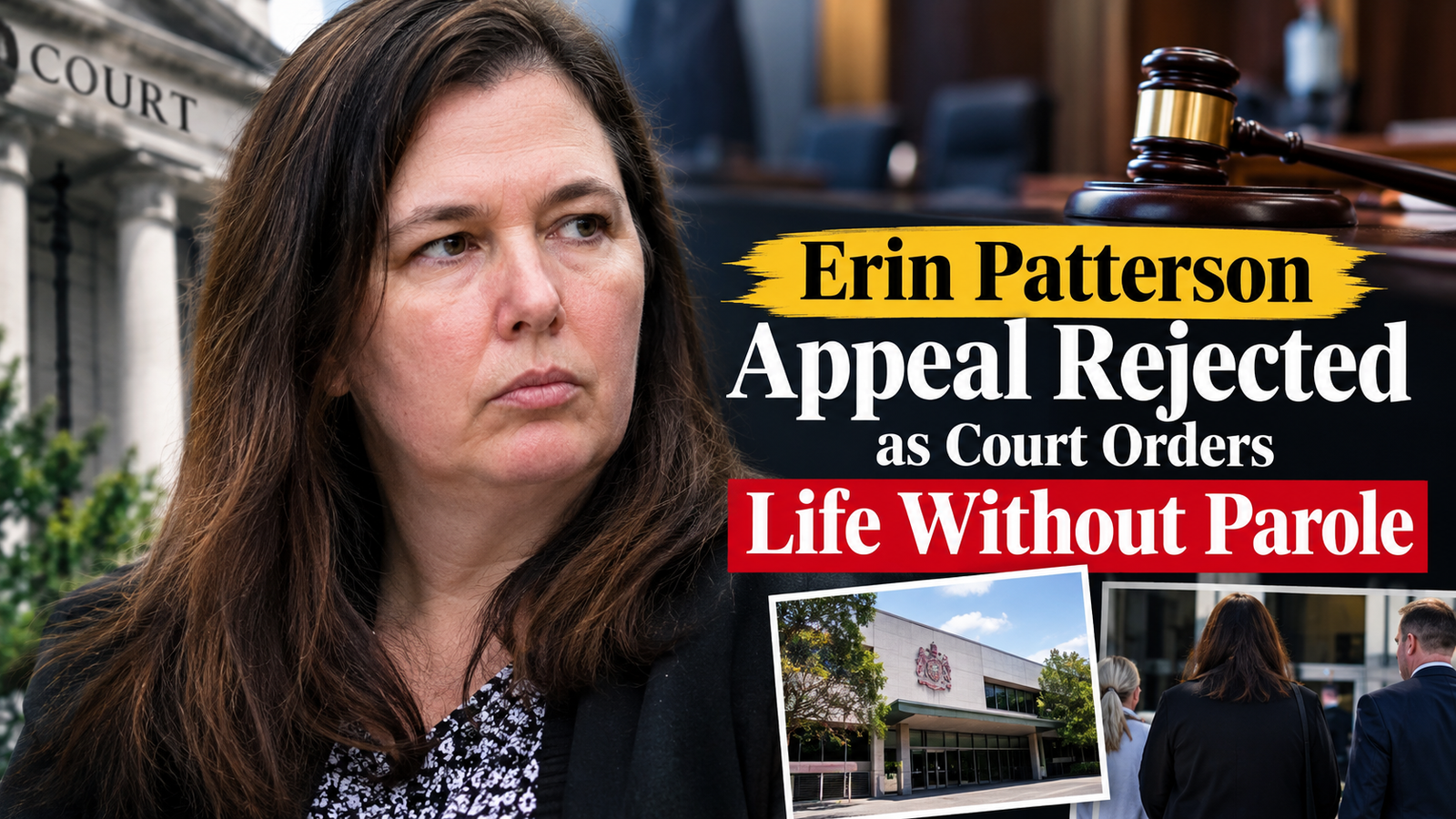
The Erin Patterson appeal has ended in a major legal setback for the Australian woman convicted of murdering three relatives with poisonous mushrooms. Victoria’s Court of Appeal has rejected her challenge to the convictions and removed the 33-year minimum prison term that previously allowed her to seek release.
The ruling, delivered on October 30, 2026, means Patterson must remain in prison for the rest of her life without the possibility of parole.
The court also accepted prosecutors’ argument that her original sentence did not adequately reflect the seriousness of the crimes. The decision follows the high-profile 2025 trial over a deadly family lunch in the Victorian town of Leongatha.
According to the Supreme Court of Victoria, the judges considered two separate appeals: Patterson’s challenge to her convictions and the prosecution’s request for a harsher sentence.
Victoria Court of Appeal Rejects Erin Patterson’s Challenge
Three judges of Victoria’s Court of Appeal delivered the decision on Friday, October 30.
Patterson had asked the court to overturn her convictions. Her legal team argued that problems surrounding the trial had created a substantial risk of injustice.
However, the judges rejected her challenge.
The prosecution also appealed the original sentence, arguing that a 33-year non-parole period was too lenient given the nature of the offences.
The court agreed with the prosecution on that issue. It set aside the minimum term and ordered life imprisonment without parole.
Justice Stephen McLeish delivered the court’s decision. He described the offending as exceptionally calculated and said its seriousness made a non-parole period inappropriate.
The ruling means Patterson has lost both parts of her appeal.
Why Erin Patterson Was Sentenced to Life Without Parole
The original sentence allowed Patterson to become eligible for parole after serving 33 years.
Because of her age at the time, she would have been around 82 before she could seek release.
Prosecutors argued that this punishment did not reflect the planning involved in the murders and the betrayal of trust within the family.
The appeal judges accepted that the original minimum term was inadequate.
They considered several aspects of the case, including the preparation of the fatal meal, the period during which the plan was allegedly carried out and the actions Patterson took after the poisoning.
The court also considered evidence of deception and the destruction of material connected to the investigation.
As a result, the judges concluded that the appropriate punishment was life imprisonment without any parole eligibility.
What Happened in the Australian Mushroom Murder Case?
The case began with a family lunch at Patterson’s home in Leongatha, a rural town in Victoria, in July 2023.
Patterson prepared a beef Wellington meal for four relatives. The food contained death cap mushrooms, which are highly poisonous and can cause fatal organ damage.
Three guests died after eating the meal:
- Don Patterson, her former father-in-law.
- Gail Patterson, her former mother-in-law.
- Heather Wilkinson, Gail’s sister.
Heather’s husband, Ian Wilkinson, also became seriously ill but survived after spending weeks in hospital.
A jury found Patterson guilty of three murders and one attempted murder in 2025.
The case attracted international attention because of the unusual poisoning method and the family relationships involved.
Patterson maintained that she had accidentally included poisonous mushrooms in the food. However, the jury found her guilty after considering the evidence presented during the trial.
Why Did Erin Patterson Challenge Her Convictions?
Patterson’s legal team argued that problems during the trial had affected the fairness of the proceedings.
One major issue involved accommodation arrangements for the jury.
During their deliberations, jurors stayed at the same hotel as the lead police witness and members of the prosecution team.
Her lawyers argued that this arrangement created an unacceptable risk of improper influence, even though there was no evidence of direct communication between the jurors and those individuals.
The defence also challenged aspects of the prosecution’s questioning of Patterson during the trial.
Her lawyers argued that the cross-examination was unfair and risked influencing the jury’s assessment of the evidence.
However, the Court of Appeal did not find grounds to overturn the convictions.
The judges’ decision leaves the original jury verdicts in place.
What Did the Judges Say About the Crimes?
The appeal ruling placed particular emphasis on the planning and circumstances surrounding the poisoning.
Justice McLeish said the offending involved an extended period of preparation and a series of deceptive actions.
The court also examined the breach of trust involved in targeting members of Patterson’s extended family.
According to the Associated Press report on the ruling, the judges considered evidence that Patterson had made misleading statements about the source of the mushrooms and destroyed evidence.
The court concluded that the seriousness of the offences justified a sentence without parole.
The ruling also addressed the prosecution’s argument that the original sentence was insufficient.
Who Was Ian Wilkinson, the Sole Survivor?
Ian Wilkinson was the only guest at the July 2023 lunch who survived the poisoning.
He was married to Heather Wilkinson, one of the three victims.
After consuming the meal, Ian became critically ill and required extensive medical treatment. He eventually recovered.
Patterson was convicted of attempting to murder him.
During the original trial, Wilkinson described the emotional impact of losing his wife and surviving the poisoning.
His testimony became an important part of the case and highlighted the lasting consequences for the surviving family members.
Can Erin Patterson Appeal to Australia’s High Court?
Although the Court of Appeal has rejected her challenge, Patterson may still have a final legal option.
She can apply to Australia’s High Court for special permission to challenge the convictions or sentence.
However, this does not mean the High Court will automatically hear her case.
The court must first decide whether to grant special leave to appeal.
According to the Associated Press, the High Court represents Patterson’s final appeal option in the Australian judicial system.
Unless a higher court changes the decision, the life-without-parole sentence will remain in effect.
Erin Patterson Case Continues to Attract International Attention
The mushroom poisoning case has become one of Australia’s most widely discussed criminal trials.
Its unusual circumstances have attracted international media coverage, documentaries, podcasts and planned television adaptations.
The story has also raised wider public interest in poisonous mushrooms and the dangers of mistakenly consuming toxic wild fungi.
The October 30 ruling marks a significant development in the case. It confirms Patterson’s convictions and removes the possibility of parole under the sentence imposed by the Court of Appeal.
For the families affected by the tragedy, the decision brings a major legal chapter to a close.
However, the possibility of a final application to Australia’s High Court means further legal developments cannot be completely ruled out.


