Hubble Reveals Ancient Merger That Helped Build the Milky Way
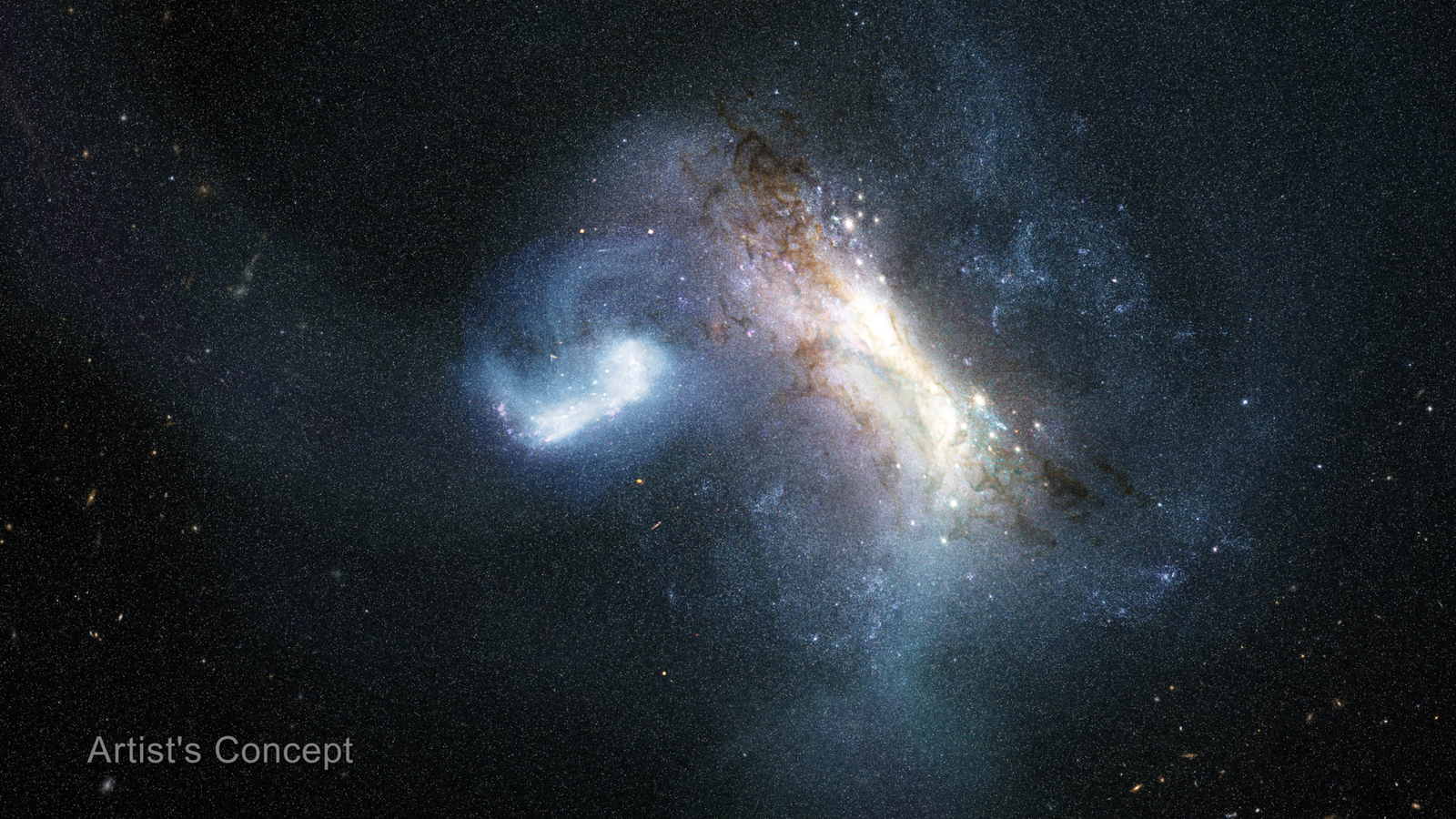
New observations from NASA’s Hubble Space Telescope provide definitive evidence that a dwarf galaxy merged with the young Milky Way about 12 billion years ago. The finding gives astronomers a clearer view of how our galaxy grew during its earliest stages.
Looking back billions of years
The merger involved a dwarf galaxy identified as LKH and a much younger Milky Way. Because the event occurred roughly 12 billion years ago, astronomers cannot observe the collision directly. Instead, they reconstruct the event from surviving stellar populations and the characteristics of globular star clusters.
Globular clusters are dense groups of stars that can preserve information about the environments in which they formed. By studying their ages, chemistry, motions, and locations, researchers can identify evidence that stars once belonged to smaller systems before those systems were absorbed by a larger galaxy.
Why galaxy mergers matter
Galaxies do not necessarily grow in isolation. Over cosmic time, gravitational interactions can bring smaller galaxies into larger systems. These mergers can add stars, gas, dark matter, and other material while changing the structure and motion of the resulting galaxy.
The Milky Way contains evidence of several ancient mergers, but reconstructing individual events is challenging. The farther back scientists look, the more the evidence has been mixed into the larger galaxy. Hubble’s observations help isolate clues that remain visible in stellar populations.
A new view of the Milky Way’s early years
The LKH merger occurred when the Milky Way was still relatively young. At that stage, the galaxy was assembling from smaller structures, making mergers an important part of its growth. The new evidence helps connect the Milky Way’s present-day structure with the processes that shaped it billions of years ago.
Researchers can compare the evidence from globular clusters with models of galaxy formation. Computer simulations predict that large galaxies should grow partly through repeated mergers, but observations are necessary to test whether individual systems followed those pathways.
Hubble’s continuing scientific role
Although Hubble has operated since 1990, its archive continues to support new discoveries. Astronomers often revisit existing observations as analysis methods improve and as new theoretical models provide different ways to interpret older data.
The telescope’s ability to resolve individual stars and compact stellar systems makes it especially useful for studying nearby galaxies and the Milky Way’s history. Its observations can also be combined with data from other space telescopes and ground-based observatories to build a more complete picture.
What the merger teaches us
The LKH result reinforces a central idea in modern astronomy: the Milky Way is a product of cosmic assembly. Its current shape and stellar populations reflect processes that unfolded over billions of years.
Understanding those events is more than a historical exercise. Galaxy mergers influence star formation, stellar orbits, gas distribution, and the development of galactic structures. By identifying individual mergers, scientists can test broader theories about how galaxies like the Milky Way form and evolve.
Sources and related reporting
Read more through the Hudson Tribune Science section, Technology section, World section, U.S. News section, Entertainment section, and Newsroom.
Sources include NASA Hubble, NASA’s Hubble mission, ESA/Hubble, Space Telescope Science Institute, NASA galaxy science, and NASA Universe.