

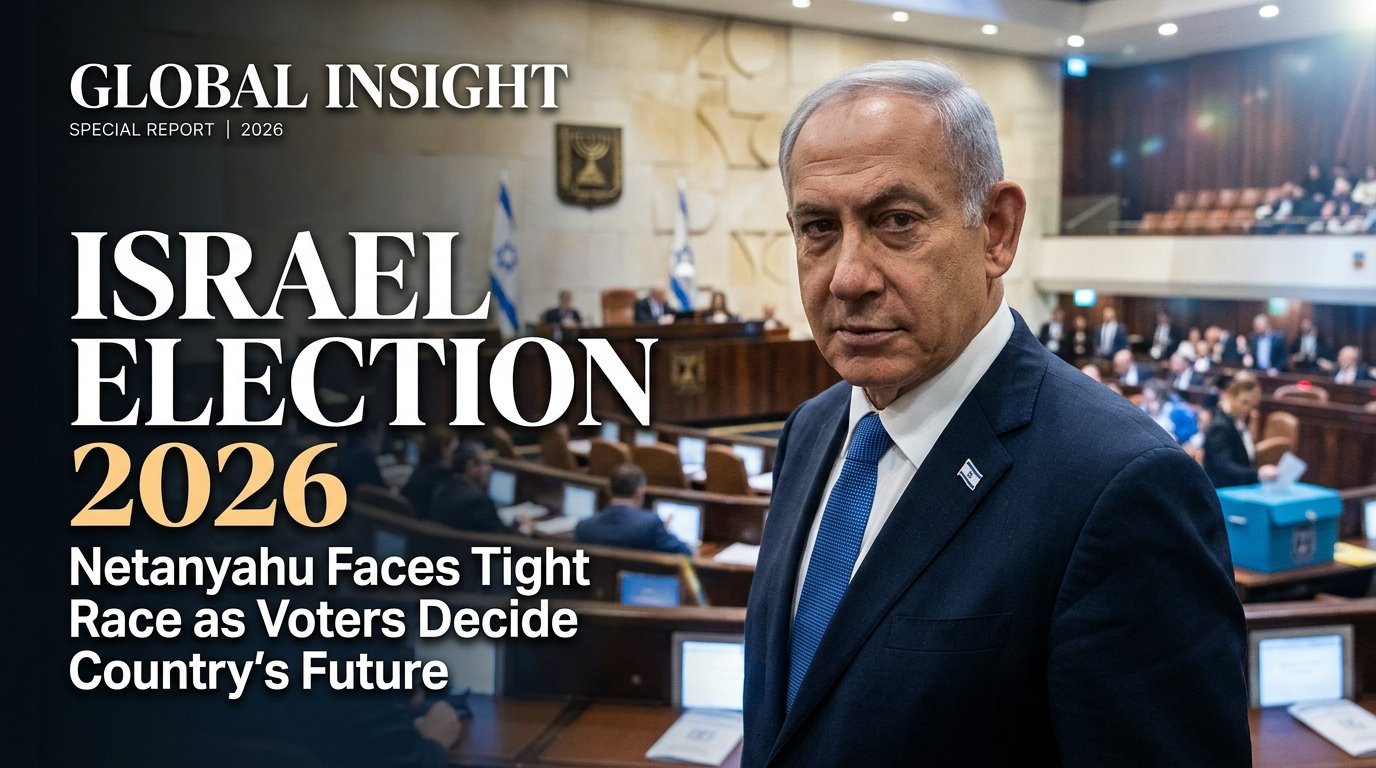
Israel’s 2026 election is putting Prime Minister Benjamin Netanyahu’s political future in the spotlight as voters choose representatives for the country’s 26th Knesset. The closely watched contest comes amid continuing security concerns, political divisions and debate over the government’s handling of the October 7, 2023, Hamas attacks.
Former military chief Gadi Eisenkot, leader of the centrist Yashar party, is among the main challengers seeking to replace Netanyahu. However, pre-election polls suggest that neither the prime minister’s allies nor the opposition may secure the 61 seats needed to command a majority in Israel’s 120-member parliament.
According to reporting by Reuters and the Associated Press on October 27, the outcome could depend on the final distribution of seats and the negotiations that follow election day. As a result, voting may not immediately determine who will lead the next government.
Israel Election 2026: Why the Race Matters
The October 27 election is Israel’s first national parliamentary vote since the Hamas-led attacks of October 7, 2023. Those attacks triggered a prolonged regional conflict and raised serious questions about Israel’s intelligence, military preparedness and national security.
Since then, the country’s political debate has been shaped by the consequences of the war, relations with neighbouring countries and disagreements over the government’s priorities.
Netanyahu is seeking another term after leading Israel through years of political turbulence and military confrontation. His supporters argue that his experience and international relationships make him a strong choice during a period of regional instability.
Opposition parties, meanwhile, have criticised his leadership and called for changes in the country’s political direction. They have also raised questions about accountability for the security failures that preceded the October 7 attacks.
Consequently, the election is about more than party representation. It could determine the direction of Israel’s security policy, domestic reforms and relations with international partners.
Benjamin Netanyahu Seeks Another Term
Netanyahu, the leader of the right-wing Likud party, is attempting to maintain power through an alliance with religious and nationalist parties.
His campaign centres on national security, military operations and his experience dealing with international leaders. Netanyahu has argued that Israel needs continued leadership to address threats from Iran and other regional adversaries.
His supporters also emphasise his relationship with US President Donald Trump, presenting cooperation between the two leaders as an important factor in Israel’s security strategy.
However, Netanyahu faces substantial political challenges. Critics have questioned his government’s handling of the October 7 security failure and its approach to the wars that followed.
The prime minister’s coalition partners also have distinct priorities, including religious policies, national identity and exemptions from mandatory military service.
Whether Netanyahu can secure enough parliamentary support to form another government remains a central question in the Israel election 2026.
Gadi Eisenkot Emerges as a Key Opposition Challenger
Gadi Eisenkot, a former chief of the Israel Defence Forces, is leading the centrist Yashar party and positioning himself as an alternative to Netanyahu.
Eisenkot has sought to appeal to voters who want a change in leadership without abandoning a strong national security approach. His military background gives him experience in defence matters, while his campaign has emphasised political accountability and national unity.
One of his central proposals is a state inquiry into the intelligence and security failures surrounding the October 7, 2023, attacks.
The issue remains politically sensitive because it concerns responsibility for one of the most serious security failures in Israel’s history.
Eisenkot’s broader challenge is to unite opposition parties that disagree on several major issues. Although these parties share opposition to Netanyahu, they differ on economic policy, religion, national security and the role of Arab-led parties in government formation.
Therefore, even a strong result for Eisenkot’s party would not automatically guarantee that he becomes prime minister.
Key Issues That Could Shape the Election
1. National security and the regional conflict
Security remains a major concern for Israeli voters following the October 7 attacks and the subsequent regional wars.
Netanyahu has argued that his government needs more time to address threats facing the country. His opponents, however, have questioned whether his leadership has delivered sufficient security and accountability.
The next government will face difficult decisions concerning military strategy, regional diplomacy and the long-term consequences of the conflict.
2. Arab voter turnout
Arab citizens of Israel could play an important role in determining the balance of power in the Knesset.
Their participation matters because the number of seats won by Arab-led parties may affect the opposition’s ability to assemble a government or support an alternative parliamentary arrangement.
However, electoral influence depends on more than turnout alone. Party performance, the distribution of votes and the willingness of other political groups to cooperate will also affect the outcome.
The relationship between Arab-led parties and the wider opposition remains a significant obstacle to forming a unified governing coalition.
3. Military service for ultra- Orthodox Jewish men
Military conscription is another major issue in the election.
Longstanding exemptions for many ultra-Orthodox Jewish men have generated debate over equality, religious freedom and the distribution of national responsibilities.
Netanyahu’s political alliance includes ultra-Orthodox parties that have traditionally defended exemptions. Several challengers want broader military-service requirements.
This dispute could complicate coalition negotiations because any agreement on conscription may affect the support of parties needed to form a government.
4. Smaller parties and the electoral threshold
Israel uses proportional representation, meaning parliamentary seats are allocated according to parties’ shares of the national vote, subject to an electoral threshold.
Under the current rules, a party generally needs at least 3.25% of the valid national vote to enter the Knesset.
As a result, smaller parties can have an outsized impact on coalition arithmetic. A party that crosses the threshold may win several seats, while one that falls short may receive no representation.
This makes smaller parties important to watch as election officials count votes and determine the final distribution of seats.
What Happens If Neither Side Wins a Majority?
Israel’s parliament has 120 seats, so a government normally needs the support of at least 61 members to command a majority.
If neither political camp reaches that number, the next government will depend on negotiations among parties.
Several outcomes are possible:
- A coalition government: Parties with enough combined seats could negotiate an agreement to govern together.
- A minority government: A candidate might attempt to govern without holding a majority of seats, provided the parliamentary circumstances allow it to take office and remain in power.
- A change in political alliances: Individual lawmakers or parties could alter their positions during negotiations, potentially changing which side can form a government.
- Another election: If no candidate can assemble a viable government through the required process, Israel could face another vote.
The country’s political history illustrates the difficulty of breaking parliamentary deadlocks. Israel held five elections between 2019 and 2022 amid repeated struggles to establish stable governing coalitions.
The final seat count, party commitments and negotiations with smaller factions will therefore be crucial in determining the next prime minister.
When Will Israel Election Results Be Final?
Initial indications may emerge from exit polls after voting ends, but exit polls are estimates rather than official results.
The official count will determine how many seats each party receives. According to Israel’s published election timetable, final results are scheduled for publication by November 4, 2026, although preliminary figures may become available earlier.
Once the results are established, President Isaac Herzog will consult political representatives and select the candidate considered most likely to form a government.
The nominee must then work to secure sufficient parliamentary support within the applicable timeframe. Coalition negotiations may take days or weeks, depending on the results and the positions of the parties involved.
For this reason, the leading party on election night will not necessarily be the party that ultimately leads the government.
What about the Israel Election 2026? Could Mean for the Country
The election could shape Israel’s political direction at a time when security, public accountability and social divisions remain major concerns.
A Netanyahu-led coalition would likely continue to rely on right-wing and religious partners, while an alternative government would face the challenge of reconciling the different priorities of opposition parties.
Both paths would involve difficult decisions on military policy, relations with Arab citizens, religious exemptions and Israel’s international relationships.
For now, the decisive question is whether either camp can build a workable parliamentary majority. Until the final results and coalition negotiations become clear, the country’s next government remains uncertain.
Sources: Reuters’ October 27, 2026, election coverage; Associated Press reporting on the election and coalition negotiations; Israel’s official Knesset and election administration websites.
This report reflects information available on October 27, 2026. Election projections and political negotiations may change as official results are released.


