

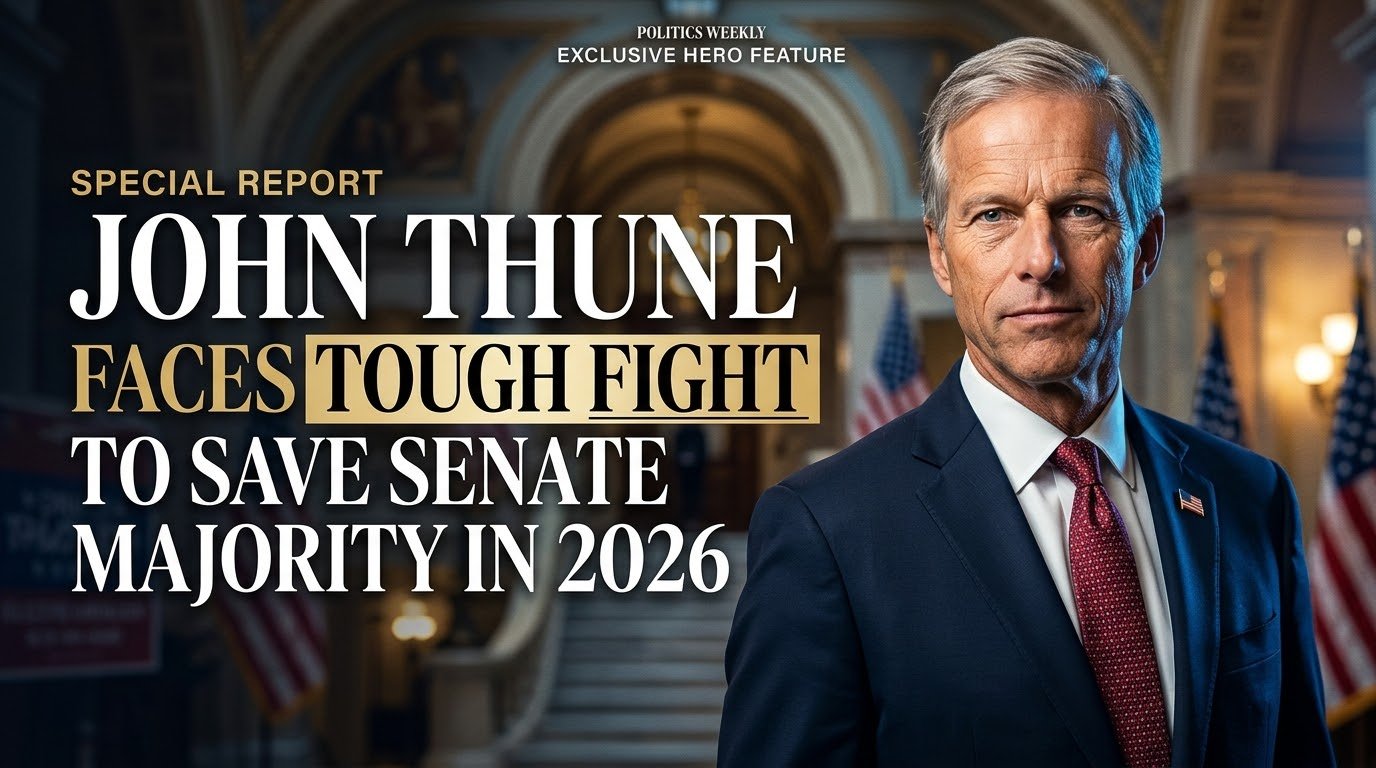
Senate Majority Leader John Thune is facing a critical political test as Republicans work to retain control of the US Senate ahead of the November 3, 2026, midterm elections. Rising fuel prices, concerns about the Iran war and growing pressure from within his own party have made the campaign increasingly challenging.
Thune, a Republican senator from South Dakota, has spent recent weeks campaigning alongside candidates in competitive Senate races. His efforts come as voters weigh the economic impact of President Donald Trump’s policies and question the direction of the administration.
The outcome could shape not only the balance of power in Congress but also Thune’s influence over the Republican Party’s legislative agenda.
Why John Thune’s Senate Majority Is Under Pressure
Republicans entered the 2026 election cycle with a favourable Senate map. However, political and economic developments have created new challenges in several states where the party had hoped to maintain a comfortable advantage.
According to recent Associated Press reporting, Republican candidates are confronting voter concerns about the Iran conflict, higher fuel costs and grocery prices. These issues have become important campaign topics, particularly in states where households and businesses are sensitive to energy expenses.
Iowa has emerged as one of the closely watched contests. Republican Representative Ashley Hinson is running for the Senate seat being vacated by Republican Senator Joni Ernst. Hinson faces Democratic state legislator Josh Turek.
Thune has campaigned with Hinson as Republicans seek to defend the seat. He has also supported Republican candidates in other states as the party tries to protect its Senate majority.
The stakes are significant. Losing even a small number of competitive races could change which party controls the chamber and determines the legislative agenda.
Iran War and Rising Gas Prices Become Election Issues
Economic concerns have become a central challenge for Republican candidates heading into the midterms.
The conflict involving Iran has disrupted energy markets and contributed to higher fuel costs. For American households, rising gasoline prices can increase the cost of commuting and transportation. Businesses may also face higher expenses for shipping, farming and other operations.
Reuters reported on October 26 that average US gasoline prices during Trump’s second term had edged above the average recorded during Joe Biden’s presidency. The comparison was based on American Automobile Association data, although inflation-adjusted measures provide additional context.
These pressures have created a difficult political environment for Republicans seeking to defend their records on the economy.
Thune has argued that the administration’s economic policies could produce longer-term benefits. However, voters facing higher costs may place greater importance on their immediate financial circumstances.
The disagreement presents a campaign challenge: Republicans must persuade voters that their broader economic agenda will deliver results while addressing concerns about prices today.
Thune Balances Support for Trump With Senate Independence
Thune’s leadership has involved managing two competing priorities: advancing Trump’s agenda and preserving the Senate’s legislative procedures.
Since becoming Senate majority leader, Thune has helped Republicans pursue major tax, border security and defence priorities. His leadership has also involved bipartisan work on issues including housing and digital financial regulation.
However, disagreements have emerged over election legislation and the Senate filibuster.
The SAVE America Act Dispute
Trump has pushed Republicans to pass the SAVE America Act, a proposal centred on stricter federal voter eligibility and identification requirements.
The legislation has become a source of tension between the White House and Senate Republican leadership. Thune has supported the measure but has acknowledged the difficulty of securing enough votes to advance it under existing Senate rules.
Most major legislation faces a 60-vote threshold to overcome a filibuster in the Senate. Republicans therefore cannot automatically pass legislation with a simple majority when opposition lawmakers maintain a procedural block.
Trump has urged Republicans to change Senate rules to make passage easier. Thune, however, has resisted eliminating the legislative filibuster, arguing that the rule could protect Republicans if Democrats regain control of the chamber.
The dispute has exposed differences between the president’s preference for faster legislative action and Thune’s more procedural approach to governing the Senate.
Pressure From Both Sides of the Republican Party
Thune has faced criticism from some conservative activists who believe he has not moved quickly enough to implement Trump’s agenda.
At the same time, critics of the administration argue that Senate Republicans have not done enough to challenge presidential decisions, particularly regarding the Iran conflict.
This leaves Thune in a difficult position. He must maintain support from Republican colleagues while helping candidates appeal to voters who may disagree with parts of the president’s record.
His approach has generally emphasised negotiation, party unity and the practical limits of Senate procedure rather than public confrontation with Trump.
Ashley Hinson’s Race Highlights the Republican Challenge
Iowa’s Senate contest illustrates the political pressures facing Thune and his party.
Hinson is seeking to succeed Ernst, whose retirement has opened a competitive seat. Her opponent, Turek, is presenting himself as an alternative for voters concerned about the administration and the cost of living.
Thune’s support gives Hinson access to a senior Republican figure who can help promote the party’s national message and encourage voter turnout.
However, campaigning alongside the Senate leader also connects candidates to the broader record of the Republican majority.
That connection can be helpful when voters approve of the party’s policies. It can become more complicated when voters are dissatisfied with economic conditions or national security decisions.
The Iowa contest is therefore part of a wider struggle over whether Republican candidates can maintain support in states that have generally favoured the party in recent national elections.
What Is at Stake for Thune After the Midterms?
The November 3 election will determine whether Republicans retain control of the Senate. The result will also influence Thune’s ability to shape legislation and negotiate with the White House.
If Republicans keep their majority, Thune is expected to pursue additional priorities, including housing and tax reform, permitting legislation and measures addressing artificial intelligence. Some of these proposals may depend on whether lawmakers can reach agreements before the end of the current congressional session.
If Democrats win control, the political environment will change substantially. A Democratic-led Senate could block or reshape many Republican proposals, creating more frequent clashes with the Trump administration.
Thune’s own leadership position will also remain important. Republican senators are expected to choose their leader after the election, and the party’s performance could influence internal discussions about its future direction.
Nevertheless, the election result will depend on more than Thune’s campaign strategy. Candidate quality, voter turnout, state-level issues and national economic conditions will all play a role.
Can John Thune Keep Republicans in Control?
Thune’s challenge is to convince voters that Republicans deserve another opportunity to govern while responding to concerns about the economy and the Iran conflict.
His leadership style favours negotiation and maintaining relationships within the party. That approach can help senators reach agreements, but it can also frustrate politicians and activists who want faster action.
The coming election will test whether Republicans can defend their Senate majority despite the political difficulties surrounding the administration.
For Thune, the result will offer an important measure of how effectively he has balanced party loyalty, legislative priorities and the Senate’s institutional role.
With Election Day approaching, the Republican campaign faces a clear challenge: turn its legislative record into a convincing argument for voters who are increasingly focused on affordability and the country’s direction.


