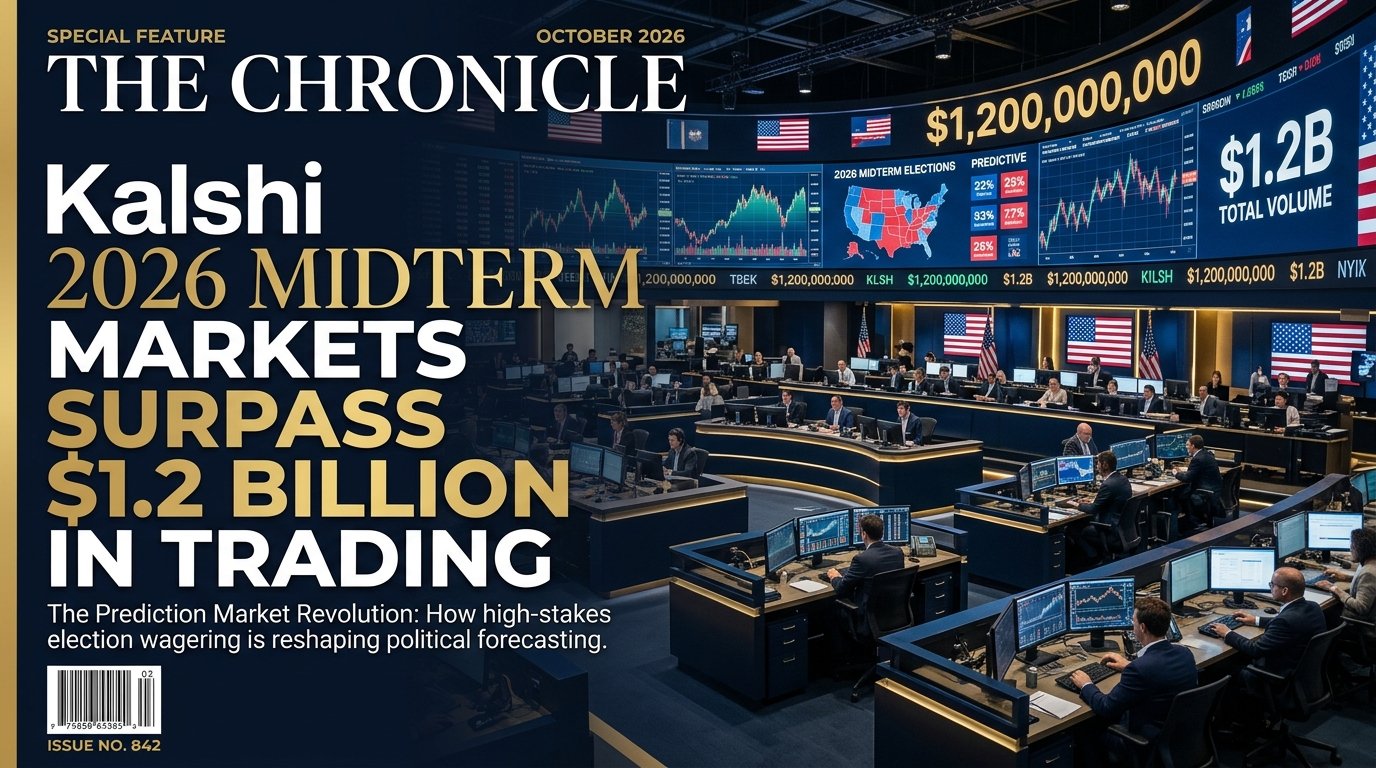
The 2026 US midterm elections are attracting significant attention from prediction market traders, with Kalshi reporting more than $1.2 billion in trading volume across its election markets. The figure has already exceeded the platform’s trading volume during the 2024 presidential election year, highlighting the growing interest in financial markets linked to political outcomes. The development is particularly notable because midterm elections traditionally receive less national attention than presidential contests.
However, traders are increasingly following races that could determine control of Congress and influence the direction of President Donald Trump’s remaining time in office. According to data shared with Fox News Digital, Kalshi’s election markets cover individual congressional and gubernatorial contests, along with the broader question of which political party will control the House of Representatives and Senate after the November elections. The platform’s growing activity also reflects a wider shift towards prediction markets, where participants trade contracts linked to the outcomes of real-world events.
The 2026 midterm elections will determine which party controls both chambers of Congress when the new session begins in January 2027. That outcome could have major implications for the administration’s legislative priorities, government oversight and political agenda. Kalshi allows eligible users to trade contracts connected to political developments and election results. As campaigns progress, market prices can change in response to new information, including candidate performances, endorsements, fundraising developments and breaking political news.
Unlike traditional opinion polls, which measure what respondents say they intend to do at a particular moment, prediction markets reflect the positions of traders participating in those markets. However, market prices should not be treated as definitive election forecasts or a replacement for established polling. The company’s Midterms Hub, launched in July 2026, brings several types of election information together. These include live market prices, polling averages, fundraising figures, historical election results and political news.
Traders Show Different Political Preferences Across Industries
One of the more interesting findings in the Kalshi data is the difference in trading preferences across professional industries. The figures shared with Fox News Digital cover 23 industries and show that traders do not have a uniform view of the political landscape. Instead, their positions vary considerably depending on their professional backgrounds. Law enforcement traders showed the strongest preference for Republican candidates, with 67.9% of their trading dollars backing Republicans. Arts and entertainment traders leaned in the opposite direction, allocating 60.1% of their money to Democratic candidates.
Other industries also showed noticeable differences. Traders associated with mining, energy and chemicals directed 62.6% of their trading dollars towards Republicans. Meanwhile, education-sector traders allocated 58.3% towards Democrats. The picture was less decisive in some other fields. Traders in legal services and electronics were almost evenly divided between the two political parties. These figures offer an interesting look at how different groups of market participants view the upcoming elections. However, they represent trading activity within particular industry groups rather than the political preferences of everyone working in those sectors.
The data also highlights differences between traders located inside key states and those participating from elsewhere. Maine and Michigan stand out because their Senate contests are attracting different levels of support from local and out-of-state participants. In Maine, 61% of the money allocated by out-of-state traders in the relevant market was placed on Democratic candidate Troy Jackson.
Among traders based in Maine, the corresponding figure was 36%. A similar pattern appeared in Michigan. Out-of-state participants allocated 65% of their trading dollars to Democratic candidate Abdul El-Sayed, compared with 49% among traders located within the state. These differences suggest that traders outside the two states are assessing the races differently from participants who live there. Still, trading patterns do not necessarily reveal which candidate has stronger support among actual voters. Market participation can be influenced by financial expectations, individual strategies and the information available to traders.
Prediction Markets Become a Bigger Part of Election Coverage
Kalshi’s trading growth comes as prediction markets gain greater visibility in American politics. The platform provides markets connected to House, Senate and gubernatorial races, allowing participants to take positions on individual contests as well as broader election outcomes. Its expansion also reflects growing interest in combining market-based forecasts with traditional political analysis. Journalists, researchers and campaign observers can examine changing market prices alongside polling, fundraising and historical voting patterns. Kalshi describes itself as a regulated prediction market exchange. The broader regulatory framework is also important because event-based trading has attracted increased attention from policymakers and financial regulators.
Reuters reported that Kalshi’s Midterms Hub combines market prices with polling and other election information. However, prediction markets also face questions about speculation, potential insider information and how accurately trading prices reflect public expectations. There is also an important distinction between trading volume and the amount of money participants actually spend. Trading volume measures the value of contracts traded under the platform’s methodology. It does not necessarily represent the total cash deposited or lost by users. As the November 2026 elections approach, activity across these markets will remain an area of interest for people following the political contest. Nevertheless, the final election results will be determined by voters, not by trading positions.