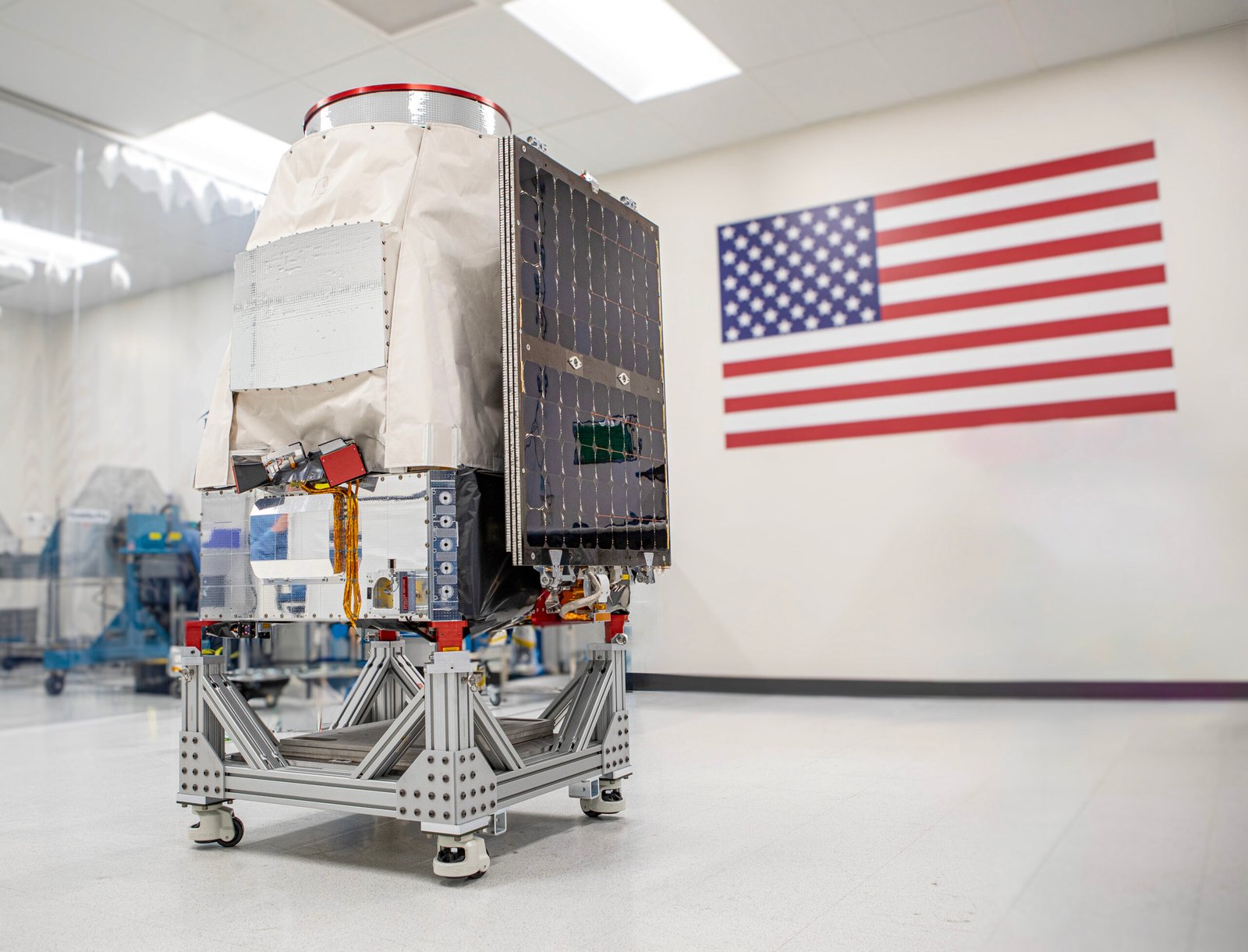
NASA’s Pandora Mission Begins Study of Exoplanet Atmospheres
NASA’s Pandora mission has begun science observations designed to improve scientists’ ability to study atmospheres on planets beyond our solar system. The spacecraft will examine exoplanets and their host stars together, addressing a major challenge in interpreting distant planetary signals.
Why host stars complicate exoplanet studies
When astronomers observe a planet passing in front of its star, some of the star’s light passes through the planet’s atmosphere. That light can contain chemical clues, including evidence of clouds, hazes, and molecules such as water. But stars themselves are active objects, and changes on their surfaces can alter the light reaching a telescope.
Pandora was designed to help separate those two effects. NASA says the mission will determine the atmospheric makeup of at least 20 exoplanets while observing the stars they orbit. By studying the star and planet together, scientists can better estimate which features in a spectrum come from the planet and which originate with the star.
A focused mission with broader value
Pandora is NASA’s first satellite to launch through the agency’s Astrophysics Pioneers program. The mission uses a relatively small spacecraft to pursue a focused scientific problem that can complement observations from larger observatories.
The approach is valuable because exoplanet atmospheres are difficult to characterize. Even when a planet is large enough to produce a measurable transit, its atmospheric signal can be extremely small compared with the brightness of its host star.
Working alongside Webb
NASA expects Pandora’s observations to improve the scientific return of the James Webb Space Telescope. Webb can conduct detailed spectroscopy, but interpreting those measurements is easier when researchers understand how the host star behaves.
Pandora therefore does not replace Webb. Instead, the missions can work together. Pandora’s repeated visible and near-infrared observations can help establish stellar baselines, while more powerful telescopes can focus on detailed atmospheric measurements.
What scientists hope to learn
The mission is designed to investigate at least 20 exoplanetary systems and determine whether their atmospheres contain features such as clouds, hazes, and water. The observations can also improve understanding of how stars affect planetary measurements.
That distinction matters when scientists assess whether a distant world is genuinely interesting. A signal that appears to come from an atmosphere can be misleading if stellar activity has not been adequately accounted for. Better separation of the two signals can make future atmospheric studies more reliable.
Why exoplanet science is accelerating
Thousands of exoplanets are now known, but detecting a planet is only the first step. Scientists increasingly want to understand how these worlds formed, how their atmospheres evolved, and whether their environments resemble or differ from those in our solar system.
Pandora represents the next stage of that effort: building cleaner observations so other instruments can answer more detailed questions. Its science will contribute to a growing effort to move from simply finding distant worlds toward understanding what those worlds are made of.
Sources and related reporting
Hudson Tribune’s Science section, Technology section, World section, Health section, U.S. News section, and Newsroom provide related coverage.
Sources include NASA Science, NASA Exoplanets, NASA Webb, NASA Universe, NASA Scientific Visualization Studio, and NASA Exoplanet Exploration.