

NASA PREFIRE Mission Maps Hidden Heat at Earth’s Poles
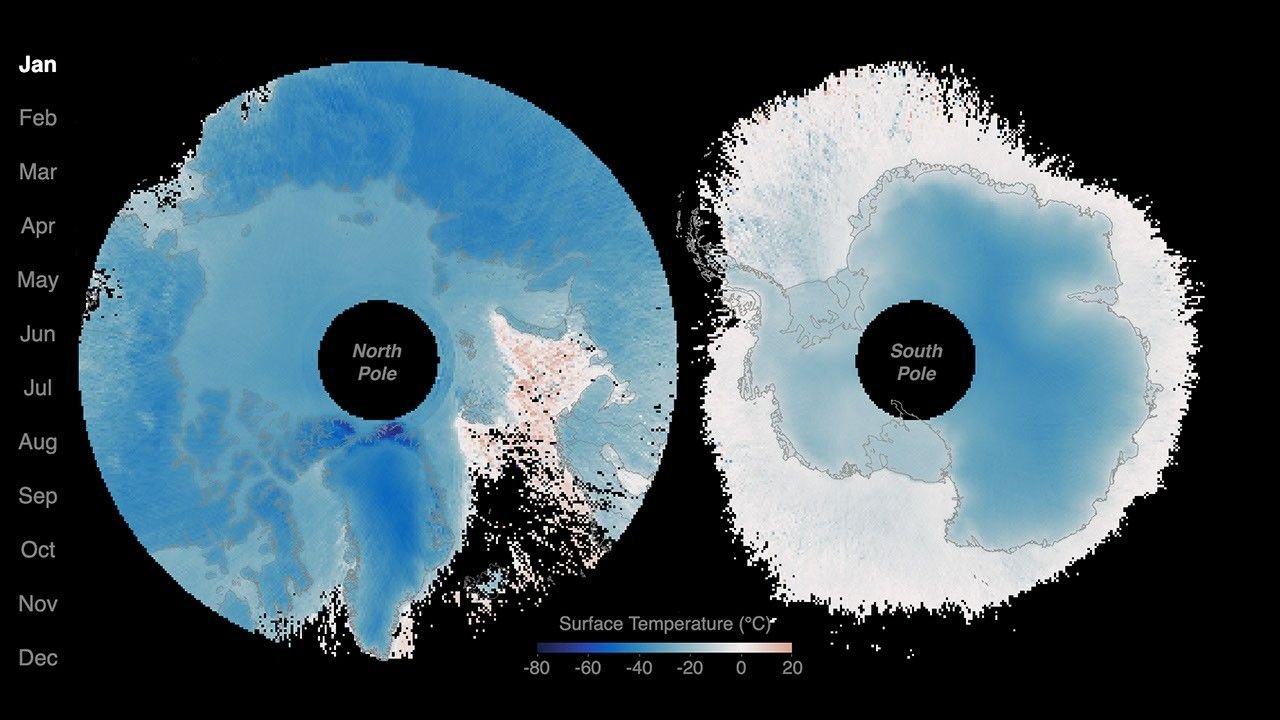
NASA’s PREFIRE mission is giving scientists a new view of how Earth’s polar regions gain and lose heat. After collecting two complete seasonal cycles, the twin CubeSats are helping researchers examine infrared energy that is invisible to the human eye.
Measuring heat that eyes cannot see
PREFIRE stands for the Polar Radiant Energy in the Far-InfraRed Experiment. Its instruments measure far-infrared radiation emitted from the Arctic and Antarctic, providing observations of part of Earth’s energy budget that has historically been difficult to measure comprehensively.
NASA says far-infrared radiation accounts for nearly 60% of the energy Earth loses to space. The poles play an important role because heat absorbed in lower latitudes is transported toward the Arctic and Antarctic through atmospheric and ocean circulation before being radiated back into space.
Two years of seasonal observations
The twin CubeSats began collecting science data in July 2024 and have now captured two complete seasonal cycles at both poles. The observations show how strongly surface temperatures fluctuate as seasons change.
Arctic winter brings long periods of darkness and intense cold, followed by summer warming that can thaw parts of the tundra and reduce sea ice. Antarctica experiences the opposite seasonal timing because it is in the Southern Hemisphere.
Why the polar energy budget matters
Earth’s climate system depends on a complicated exchange of energy. Sunlight warms the surface, the surface and atmosphere interact, and energy eventually escapes into space. Polar regions are especially important because changes in ice, snow, clouds, and atmospheric conditions can alter how efficiently heat leaves the planet.
Better measurements can improve computer models used to understand climate and weather. NASA researchers say PREFIRE data may help refine forecasts involving weather systems, river flows, shipping routes, and ice-sheet stability.
A mission built around small satellites
PREFIRE uses two relatively small CubeSats rather than a single large observatory. Their measurements can be compared across different polar conditions and seasons, creating a broader dataset than isolated observations.
The mission also demonstrates how specialized instruments can target a specific scientific gap. Instead of trying to measure every aspect of Earth simultaneously, PREFIRE focuses on a portion of the infrared spectrum that has important implications for understanding the planet’s energy balance.
From observations to better models
Satellite observations do not automatically produce a complete climate forecast. Scientists must combine measurements with atmospheric models, surface observations, ocean information, and other satellite datasets. PREFIRE adds a new layer to that broader system.
The mission’s long-term value will depend on how researchers use its measurements to test and improve models. Better representation of polar heat loss can make simulations more realistic and help scientists understand how changes at the poles connect with conditions elsewhere on Earth.
Sources and related reporting
More Hudson Tribune science coverage is available through the Science section, Technology section, World section, U.S. News section, Health section, and the Newsroom.
Sources include NASA Earth Observatory, University of Wisconsin PREFIRE, NASA Earth Science, NASA Jet Propulsion Laboratory, NOAA National Centers for Environmental Information, and NASA Earthdata.



1 thought on “NASA PREFIRE Mission Maps Hidden Heat at Earth’s Poles”
Fun88mx1 es donde encuentro la mejor acción. Siempre hay algo emocionante pasando y los premios son bastante buenos. Si buscas un lugar con mucha adrenalina, visita fun88mx1.