

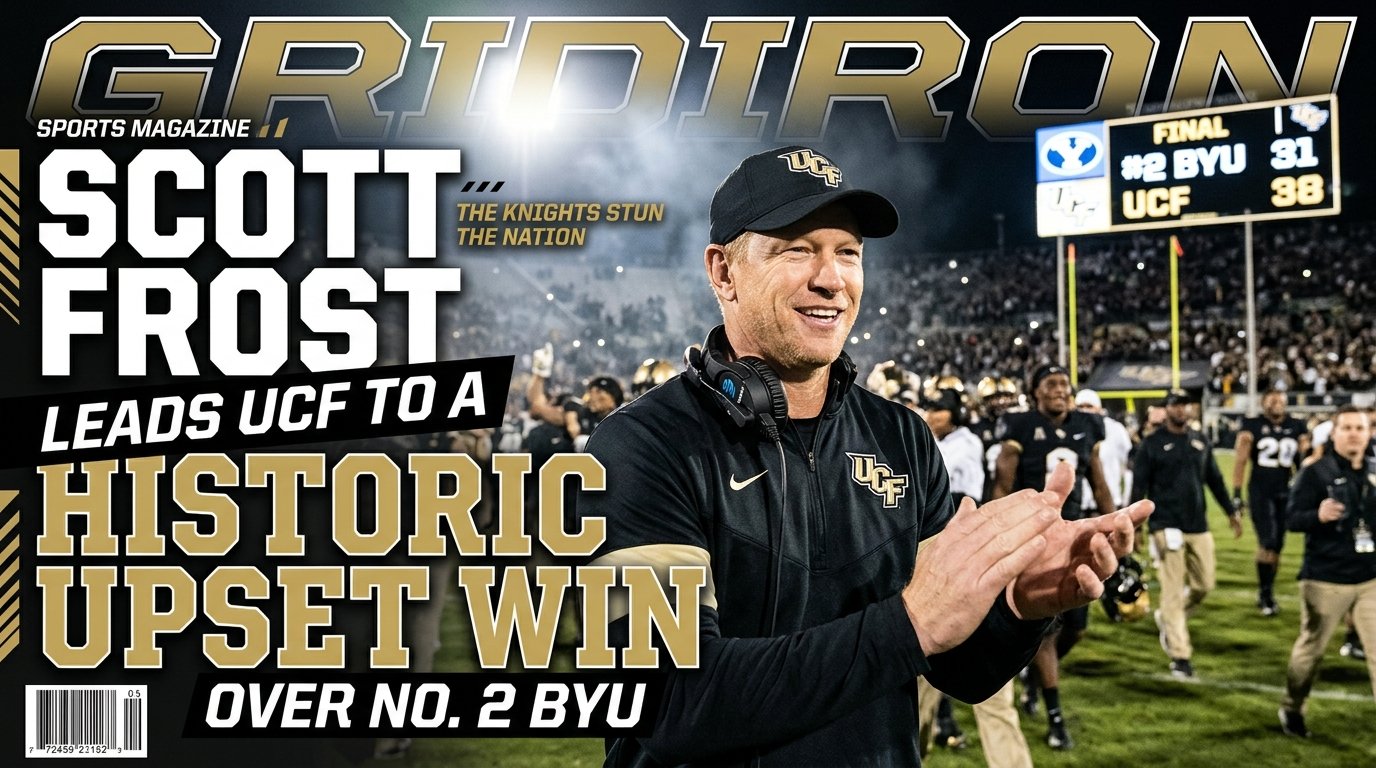
Scott Frost and the UCF Knights delivered one of the biggest victories in program history on October 24, 2026, defeating No. 2 BYU 39-31 in a dramatic double-overtime college football game in Orlando, Florida. The Scott Frost UCF win over BYU marked the Knights’ first victory against an AP top-five opponent and gave the program a major boost during Frost’s second stint as head coach.
Backup quarterback Keyone Jenkins played a decisive role in the upset. He threw the go-ahead touchdown in the second overtime and helped UCF overcome a series of late-game challenges. The victory also offered Frost an important milestone after several difficult seasons at Nebraska. UCF Athletics Associated Press
UCF Stuns No. 2 BYU in a Thrilling Finish
The Knights entered the matchup looking to make a statement against one of the nation’s highest-ranked teams. BYU had built an unbeaten record and arrived in Orlando following a notable victory over Notre Dame.
However, UCF refused to back down. Both teams traded scoring opportunities throughout the contest, creating a tense finish that eventually required two overtime periods to determine the winner.
The Knights finally secured the 39-31 victory when BYU failed to convert a fourth-down pass in the second overtime. The result ended the Cougars’ unbeaten start to the season and established a new milestone for UCF football.
According to UCF’s official athletics website, the win was the programme’s first against an AP top-five opponent. It also demonstrated that the Knights could compete with an established national contender in the Big 12 Conference.
Keyone Jenkins Delivers When UCF Needs Him Most
Jenkins emerged as one of the biggest stories of the game. The quarterback entered the season as a backup but received additional responsibility after starter Alonza Barnett III suffered a hamstring injury.
The former Florida International University quarterback used his experience to guide UCF through a demanding matchup. According to the Associated Press, Jenkins completed 25 of 41 passes for 293 yards and three passing touchdowns. He also scored on a rushing play.
His most important contribution came during the overtime periods.
A decisive touchdown in double overtime
BYU initially took a 31-24 lead in the first overtime after quarterback Bearbachmeier connected with Legend Glasker for a touchdown.
Jenkins responded immediately. He found Josh Derry for a touchdown on UCF’s first play of its possession, tying the game at 31-31.
The second overtime brought another opportunity for the Knights. Jenkins threw a touchdown pass to tight end Grayson Brousseau, giving UCF the lead. The offence then converted a two-point attempt to extend the advantage to 39-31.
BYU needed a touchdown and a successful two-point conversion to continue the game. However, Bachmeier’s fourth-down pass to Walker Lyons fell incomplete, securing the victory for UCF.
The finish highlighted Jenkins’ composure and the importance of having experienced players available when injuries affect a team’s starting lineup.
Scott Frost Reaches an Important Coaching Milestone
The win carried additional significance for Frost, who returned to UCF after a difficult period at Nebraska.
Frost previously led the Knights to an undefeated 13-0 season in 2017. That campaign included a Peach Bowl victory over Auburn and established UCF as one of the most successful programmes outside the traditional college football power structure.
His move to Nebraska brought high expectations. However, the results did not match the optimism surrounding his appointment.
Frost finished his Nebraska tenure with a 16-31 record over five seasons. His teams also struggled against ranked opponents, creating a difficult contrast with his earlier success in Orlando.
The victory over BYU offered a reminder of what Frost had accomplished during his first stint at UCF. More importantly, it showed that his current team could produce a significant result against elite competition.
Frost has also emphasised that coaching success depends on more than the head coach alone. Player development, recruiting, administrative support and the quality of the coaching staff all contribute to a programme’s performance.
His latest victory reinforces that broader message while giving UCF an opportunity to build momentum.
UCF Overcomes Injuries and Quarterback Uncertainty
The Knights faced several challenges before the BYU matchup. Barnett’s absence forced the coaching staff to rely on Jenkins, who had not received extensive preparation with the first team during the preseason.
That situation made quarterback depth especially important.
College football teams increasingly depend on transfer players to fill roster gaps and provide experience. Jenkins brought previous starting experience from FIU, giving UCF another option when its original starter became unavailable.
His performance against BYU demonstrated the potential value of recruiting experienced backup quarterbacks.
Roster depth becomes a major factor.
Injuries can quickly change a team’s season, particularly at quarterback. A reliable second option can help prevent one injury from derailing an entire campaign.
UCF’s approach also reflects the changing economics of college football. Programs must evaluate talent carefully while balancing roster needs, transfer opportunities and spending priorities.
Athletic director Terry Mohajir has stressed the importance of identifying players who can contribute rather than relying solely on expensive recruiting targets.
For UCF, Jenkins’ performance provided a practical example of that strategy. The Knights received a decisive contribution from a player whose experience helped him handle an unexpected opportunity.
A Historic Victory Does Not Guarantee Consistent Success
Although the BYU win was a major achievement, UCF still faces the challenge of turning occasional success into sustained performance.
The Big 12 includes programmes with established recruiting networks, substantial financial resources and years of experience competing at a high level. Beating one of those teams is an important step, but maintaining that standard requires continued development.
Frost has identified consistent competitiveness as a major objective for the Knights. The programme must continue improving its roster, developing players and making effective use of available resources.
The transfer portal adds another challenge because teams regularly need to rebuild portions of their rosters. Injuries and player movement can create uncertainty from one season to the next.
UCF’s growing university community and alumni network may provide opportunities to strengthen its athletic department. However, additional investment alone will not guarantee success. Recruiting decisions, coaching and player development will remain essential.
UCF Turns Its Attention to Baylor
The Knights had little time to celebrate after defeating BYU. Their next scheduled game was against Baylor on Friday, October 30, 2026.
The short turnaround created an immediate test for Frost and his players. They needed to recover from a physically demanding double-overtime contest while preparing for another Big 12 opponent.
For Jenkins and the rest of the offensive, the challenge was to reproduce the execution that helped them defeat BYU. For the coaching staff, the priority was to ensure that one historic victory became a foundation for further progress.
UCF’s result also illustrated the competitive balance across college football. Even highly ranked teams can struggle when opponents execute effectively, exploit mistakes and remain composed in crucial situations.
The Knights now have an important opportunity to show that their win over BYU represents meaningful progress rather than an isolated result.
Conclusion
Scott Frost’s UCF win over BYU marked a defining moment in the Knights’ 2026 season. The 39-31 double-overtime victory gave the programme its first win against an AP top-five opponent and showcased Keyone Jenkins’ ability to perform under pressure.
For Frost, the result also represented a significant milestone following his difficult experience at Nebraska. However, the next challenge is maintaining consistency in a competitive Big 12 environment.
If UCF can build on this performance through effective recruiting, player development and roster management, the victory could become an important step in the programme’s long-term growth.


